Pressure and mental load
See whether demands are competing for attention, unfinished tasks remain mentally active, or concentration and decisions are requiring more effort than usual.
- Competing demands
- Mental carryover
- Focus and decisions

Pressure becomes actionable when you can see its main cost: scattered attention, shorter patience, physical tension, difficulty switching off, reduced recovery, or the extra effort required just to keep normal responsibilities moving.
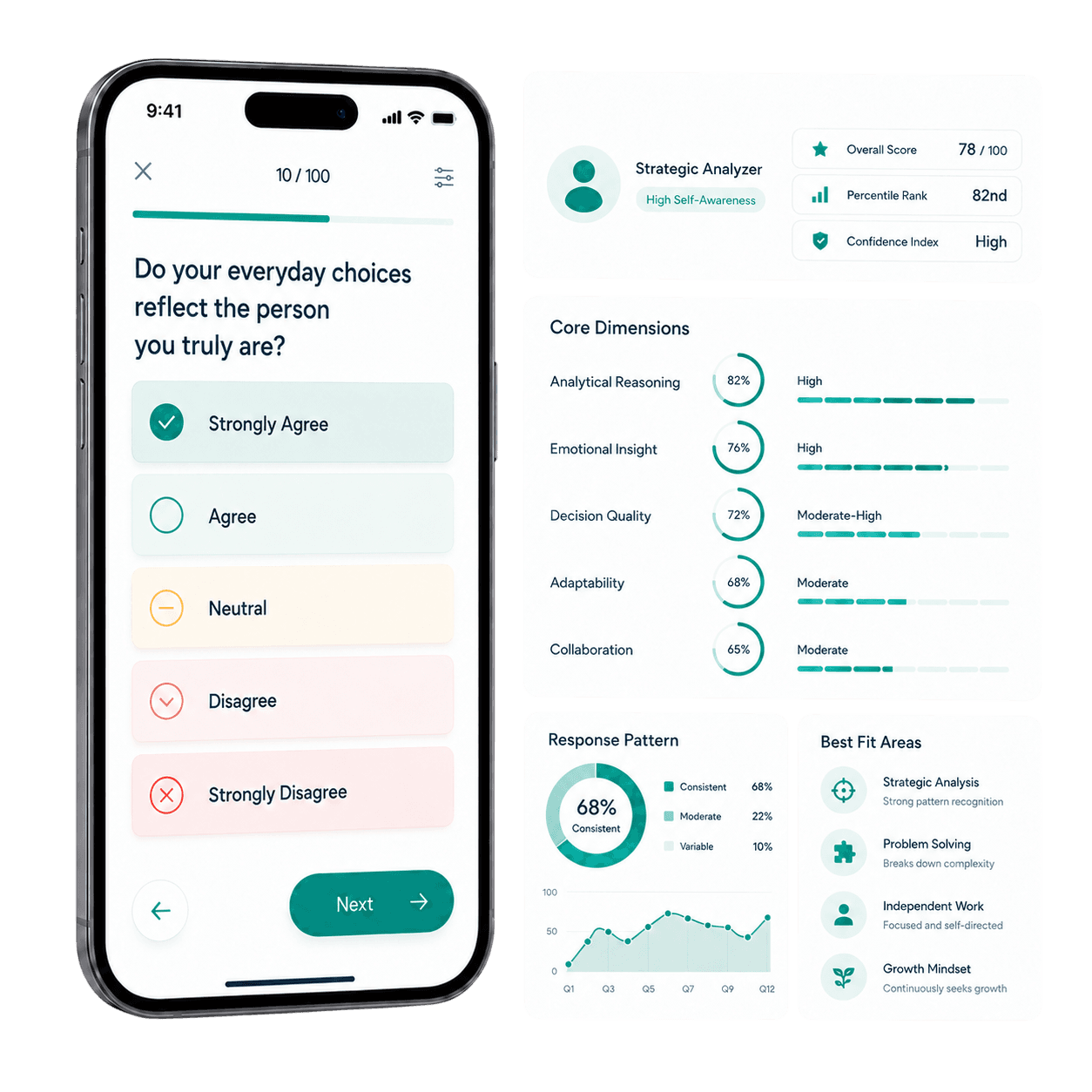
The assessment covers several stress themes, but it does not score them separately. The useful job is connecting the overall level with the real-world effect that deserves attention first.
See whether demands are competing for attention, unfinished tasks remain mentally active, or concentration and decisions are requiring more effort than usual.
Look for irritability, reduced patience, feeling on edge, muscle tension, restlessness, headaches, or other signs that pressure is extending beyond the task itself.
Decide whether the priority is reducing demand, clarifying priorities, protecting recovery, setting a boundary, asking for support, or discussing persistent symptoms with a professional.
Use what has been typical recently rather than one unusually difficult deadline or one calm day.
Your answers place you from Minimal to Severe Stress. Pressure, cognitive overload, emotional tension, physical activation, and recovery/control contribute to that one result rather than separate sub-scores.
Use the report to identify the clearest practical cost and decide whether the first response should be workload change, stronger limits, recovery, support, or professional guidance.
No. TestCore uses its own questionnaire and scoring. It is not the PSS-10, DASS-21, or another named clinical or research instrument.
You receive one overall Level 1–5 result: Minimal, Mild, Moderate, High, or Severe Stress, followed by report content explaining the broader pattern.
No. The questionnaire includes pressure, cognitive overload, emotional tension, physical activation, and recovery/control, but these themes combine into one overall stress result.
No. It cannot diagnose anxiety, depression, burnout, trauma-related conditions, or medical causes of physical symptoms.
Yes. Short-term stress is a normal response to demands. The more important practical question is whether pressure is recurring, recovery is incomplete, and functioning is becoming more costly.
Choose the clearest cost reflected in your recent life — workload, mental overload, physical tension, reduced patience, lack of control, or poor recovery — and decide what can realistically change first. Seek qualified support when symptoms are persistent, severe, or significantly affecting functioning.
The aim is not to optimize a score. It is to identify whether pressure is exceeding recovery and where one realistic change could reduce the cost.