Catch your own emotional signal earlier
See whether you notice what you are feeling before it changes your tone, attention, decisions, or ability to listen.
- Self-awareness
- Emotional clarity
- Recognizing defensive reactions
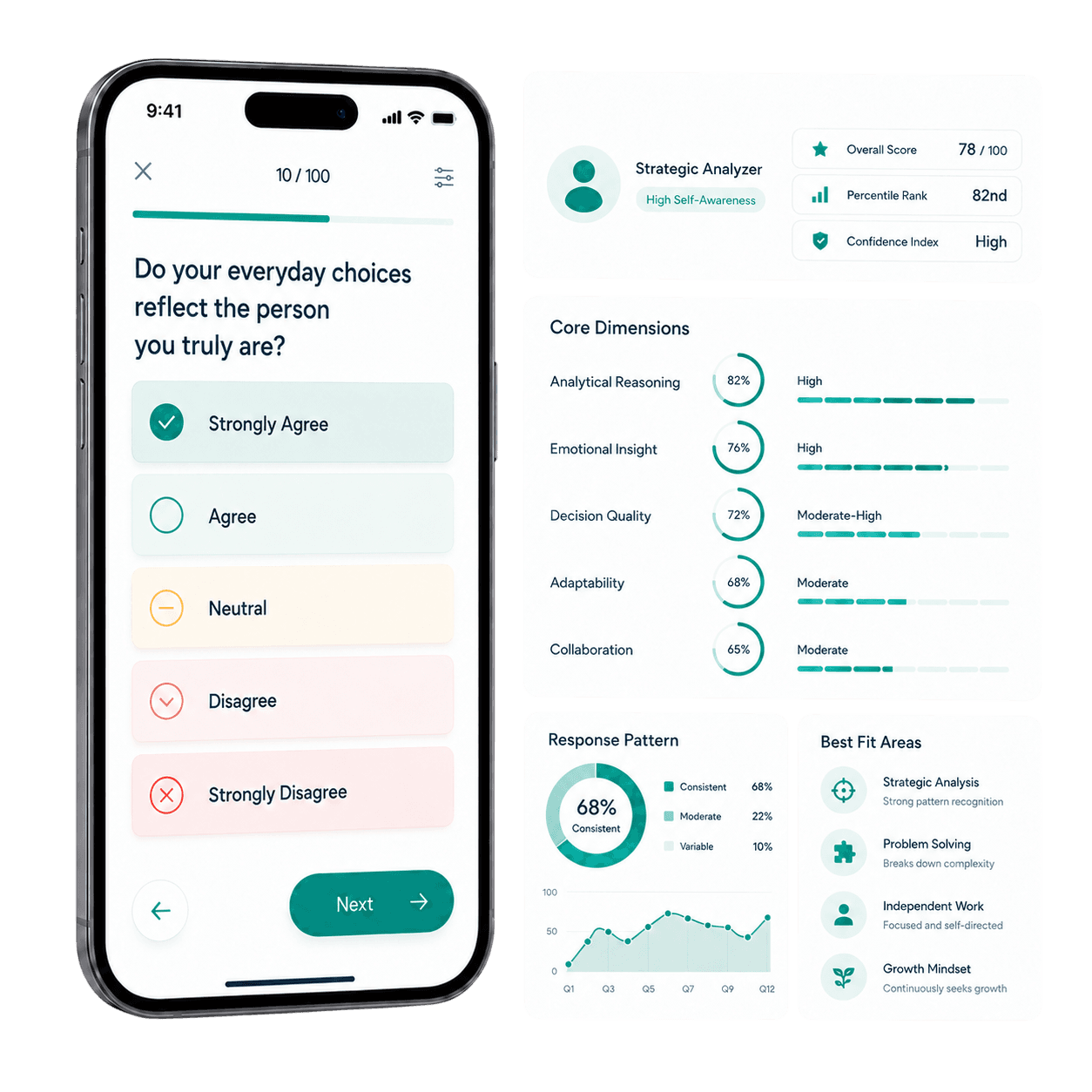
Check how you notice your own feelings, stay constructive under pressure, read other people, communicate through tension, and adapt when the first response is not working.
Emotional intelligence matters most when the situation is inconvenient: criticism, conflict, uncertainty, disappointment, pressure, or another person's strong reaction.
See whether you notice what you are feeling before it changes your tone, attention, decisions, or ability to listen.
Look at whether you can pause, regain perspective, tolerate discomfort, and keep acting in line with the outcome you actually want.
Check how empathy, communication, feedback, conflict, and adaptability affect the quality of your relationships and decisions.
Think about what you usually do when you are frustrated, criticized, uncertain, emotionally overloaded, or trying to respond to someone else's distress.
Your answers across awareness, regulation, empathy, communication, and adaptability combine into one overall emotional-intelligence result.
Use the report to connect the result with conversations, decisions, work, relationships, stress, and the situations where a different response would make the biggest practical difference.
This assessment looks across self-awareness, emotional regulation, empathic understanding, social communication, and adaptability or motivation. The final result reflects the overall pattern across those areas.
Yes in common usage. EQ, or emotional quotient, is widely used as shorthand for emotional intelligence, although different assessments may define and measure it in different ways.
You receive one overall emotional-intelligence level and a detailed report that connects the result with emotional habits, relationships, communication, daily functioning, decisions, and areas for growth.
No. Those areas are represented in the assessment and report, but the core result is one overall EQ level rather than a set of separate validated subscale scores.
Many of the behaviors involved can improve with practice, including recognizing emotions earlier, pausing before reacting, checking assumptions, communicating clearly, tolerating discomfort, and adapting when a response is not working.
No. TestCore provides an educational self-reflection assessment. It is not a diagnosis, recruitment test, or professional certification of emotional ability.
The useful part of an emotional-intelligence result is not the label. It is recognizing the situations where your current habits help, and the situations where they create avoidable cost.