Testcore

Find where self-esteem starts changing your next move

Self-doubt matters most when it alters behaviour: you stay quiet, seek one more reassurance, accept a crossed boundary, avoid a challenge, or treat one mistake as evidence that you are not capable. This test helps you locate those patterns.

Fast results
Secure
Private
Trusted by thousands of curious users
Rated 4.8/5by our users
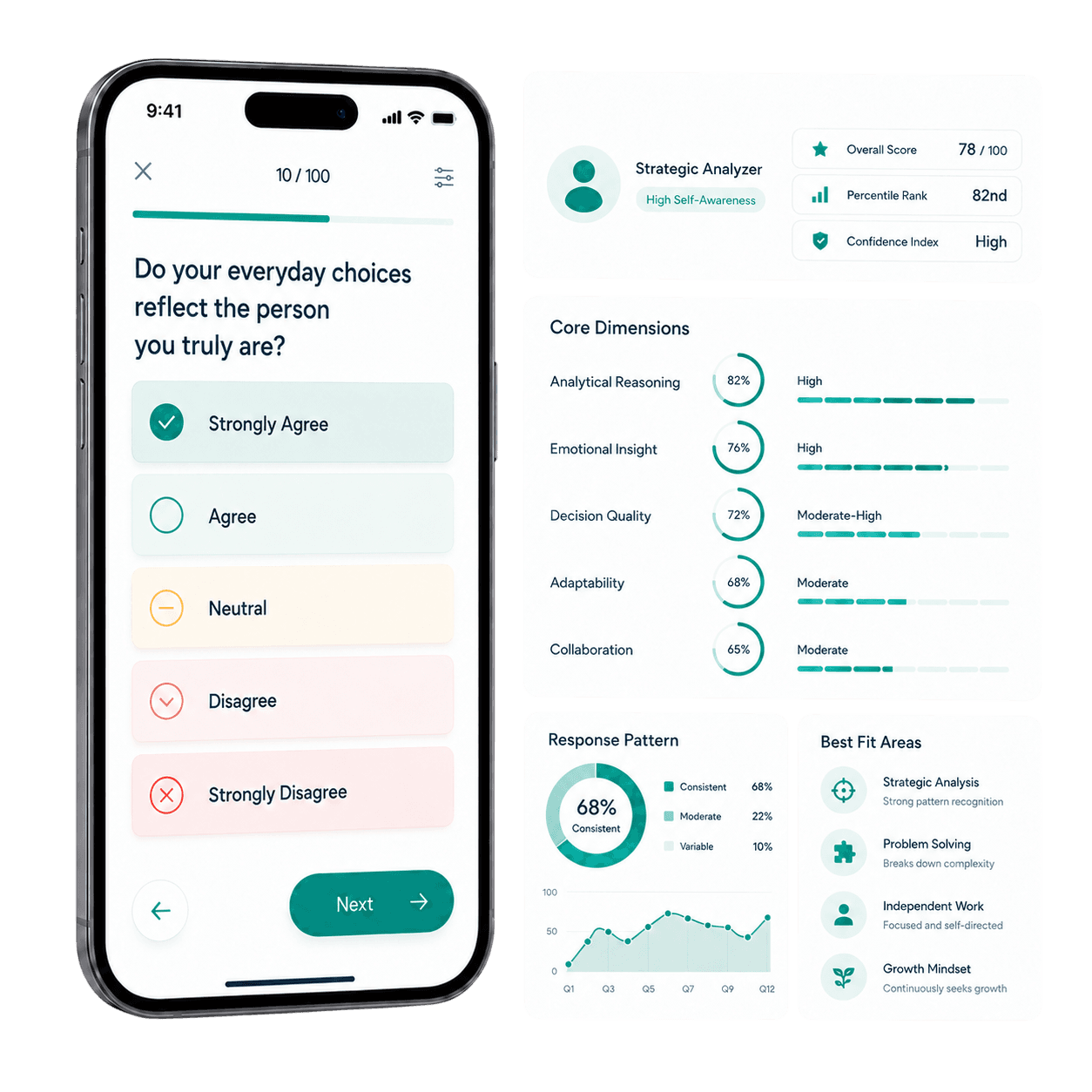
Preview of the TestCore self-esteem test report

Turn a broad self-esteem result into practical pressure points

The assessment returns one overall self-esteem level. Its practical value comes from seeing where self-worth, confidence, boundaries and recovery are changing what you actually do.

Find the thought that turns a setback into a verdict

Notice where a mistake, rejection or criticism stops being information about one event and starts becoming a conclusion about your competence or worth.

  • Mistake versus identity
  • Feedback versus self-rejection
  • Comparison versus direction

See where doubt changes the decision

Look for the moments where uncertainty leads to silence, delay, reassurance-seeking, overpreparation or avoiding an opportunity you would otherwise want.

  • Decision confidence
  • Willingness to try
  • Recovery after errors

Locate the boundary that disappears under pressure

Examine whether your needs still count when another person is disappointed, more forceful, or in a position of authority.

  • Saying no
  • Asking directly
  • Keeping your judgment

How it works

1

Answer from recurring situations

Think about mistakes, decisions, comparison, criticism, disagreement and social pressure rather than one unusually good or difficult day.

2

See your overall self-esteem level

Your answers place you on one of five overall levels, from very low to very strong self-esteem. The test does not return five separate numeric sub-scores.

3

Choose one real pressure point to work with

Use the report to identify where your self-view is most likely to change a decision, boundary, conversation or recovery after a setback.

Frequently asked questions

Q

Is this the Rosenberg Self-Esteem Scale (RSES)?

No. TestCore uses its own broader self-esteem assessment and does not claim Rosenberg/RSES validation or equivalence.

Q

What result will I see?

You receive one overall self-esteem level: very low, low, balanced, strong, or very strong, followed by a report that explains the result in everyday contexts.

Q

Does the test give separate scores for confidence, boundaries or self-worth?

No. Those themes are represented in the questions and report, but the final scoring output is one overall self-esteem level rather than separate numeric sub-scores.

Q

Is higher self-esteem always better?

The useful goal is a realistic, durable self-view. That includes being able to recognise strengths, accept correction, protect reasonable needs and recover without needing to feel superior or certain all the time.

Q

Can self-esteem change?

Yes. Experiences, relationships, work, health, rejection, achievement and repeated habits can all change how stable self-esteem feels across time and situations.

Q

Is this a clinical test?

No. It is a self-reflection assessment, not a diagnosis or a substitute for professional mental-health care.

Use the result at the moment self-doubt normally takes over

An overall score is only useful if you can connect it to a situation where a different response would matter. Look for the earliest point where self-doubt starts changing behaviour.

Before you ask for reassurance you do not actually need
Before one mistake becomes a conclusion about your ability
Before fear of disappointment erases a reasonable boundary
Before comparison makes you abandon a goal that still matters
Start the test
Takes around 10 minutesPrivate and secure