Spot the pressure point
Notice what changes when you feel ignored, challenged, compared, criticised or denied the recognition you expected.
- Recognition
- Criticism
- Comparison
The practical question is not whether you like praise or feel confident. It is what happens when recognition disappears, criticism lands badly, someone else succeeds, or another person's needs compete with your own.
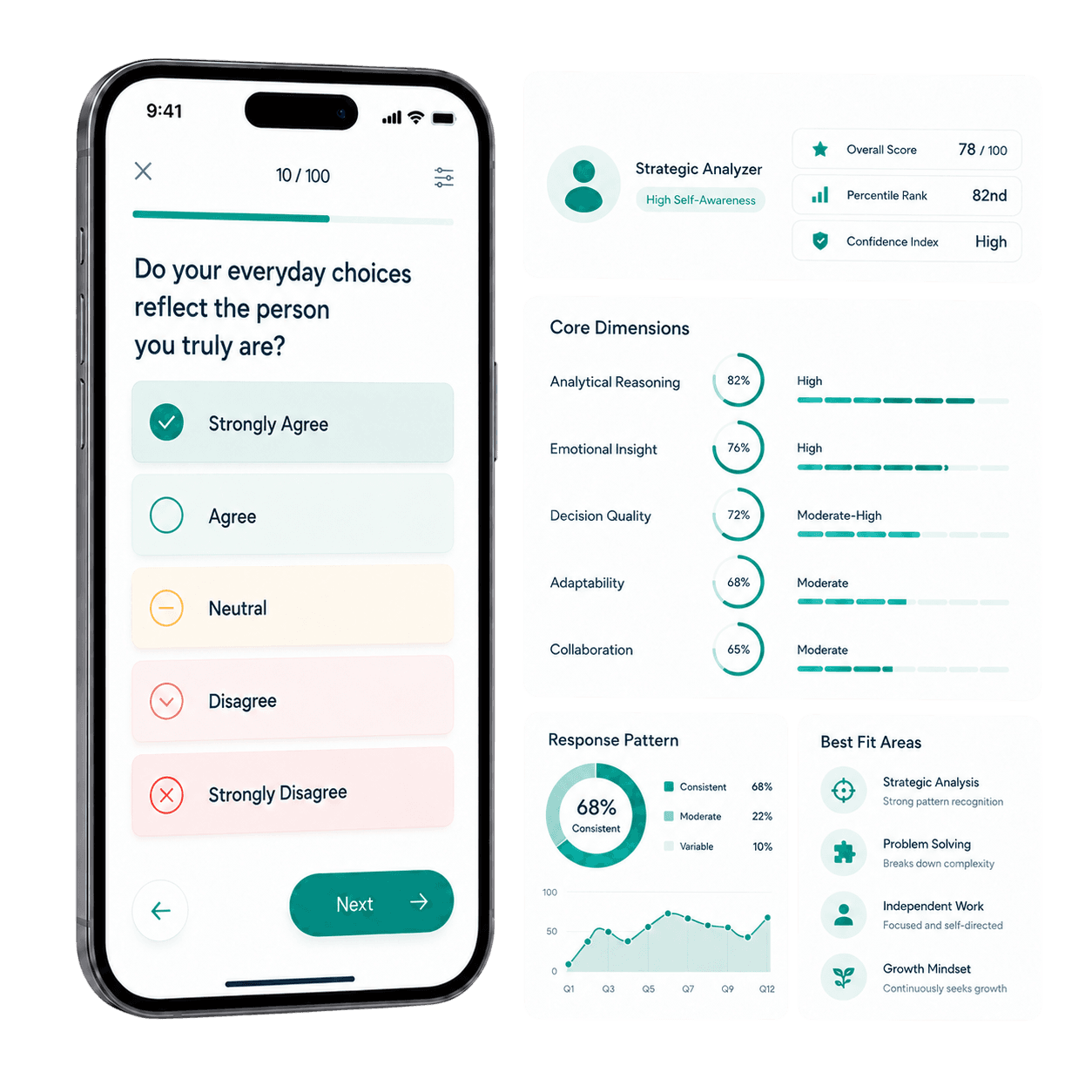
The assessment brings together recognition, entitlement, comparison, self-focus, empathy, criticism and control so you can see where a tendency begins and what it changes in the next interaction.
Notice what changes when you feel ignored, challenged, compared, criticised or denied the recognition you expected.
Look for defensiveness, self-promotion, entitlement, control, withdrawal, dismissal of feedback or a stronger need to prove your value.
Ask whether the response makes listening, accountability, shared attention or another person's perspective harder to maintain.
Think about praise, status, competition, mistakes, criticism, conflict and the moments when someone else needs attention or influence too.
The assessment combines many self-reported tendencies into one broad result rather than deciding anything from one confident, selfish or defensive moment.
Use the report to identify a practical pattern — praise dependence, comparison, entitlement, defensiveness or conversational self-focus — and notice it before it decides the interaction for you.
It reflects self-reported tendencies involving recognition and admiration, entitlement, superiority, comparison, criticism sensitivity, self-focus, empathy, listening, achievement and control.
No. It is an educational self-reflection assessment. Narcissistic personality disorder requires professional evaluation of a broader, persistent pattern and its impact on functioning.
Not by itself. The more useful questions are how dependent your confidence becomes on praise, what happens when recognition is absent and whether that need repeatedly affects reciprocity or behaviour.
No. The test is designed for your own answers about yourself and cannot validly diagnose a partner, parent, colleague or friend from your observations.
No. The assessment returns one overall narcissistic-traits range rather than a named grandiose or vulnerable subtype.
Use it to notice one recurring behaviour earlier in real life and test whether a more deliberate response improves feedback, conflict, collaboration or closeness.
The most useful outcome is a clearer view of where self-image changes your response and what you can do differently before the cost appears.