Testcore

Take the anxiety test and see whether the same pattern keeps showing up in different parts of your life.

Worry can look like preparation. Avoidance can look like waiting for the right moment. Reassurance can feel like problem-solving. TestCore helps you put those experiences side by side and see your overall anxiety-traits pattern.

Fast results
Secure
Private
Trusted by thousands of curious users
Rated 4.8/5by our users
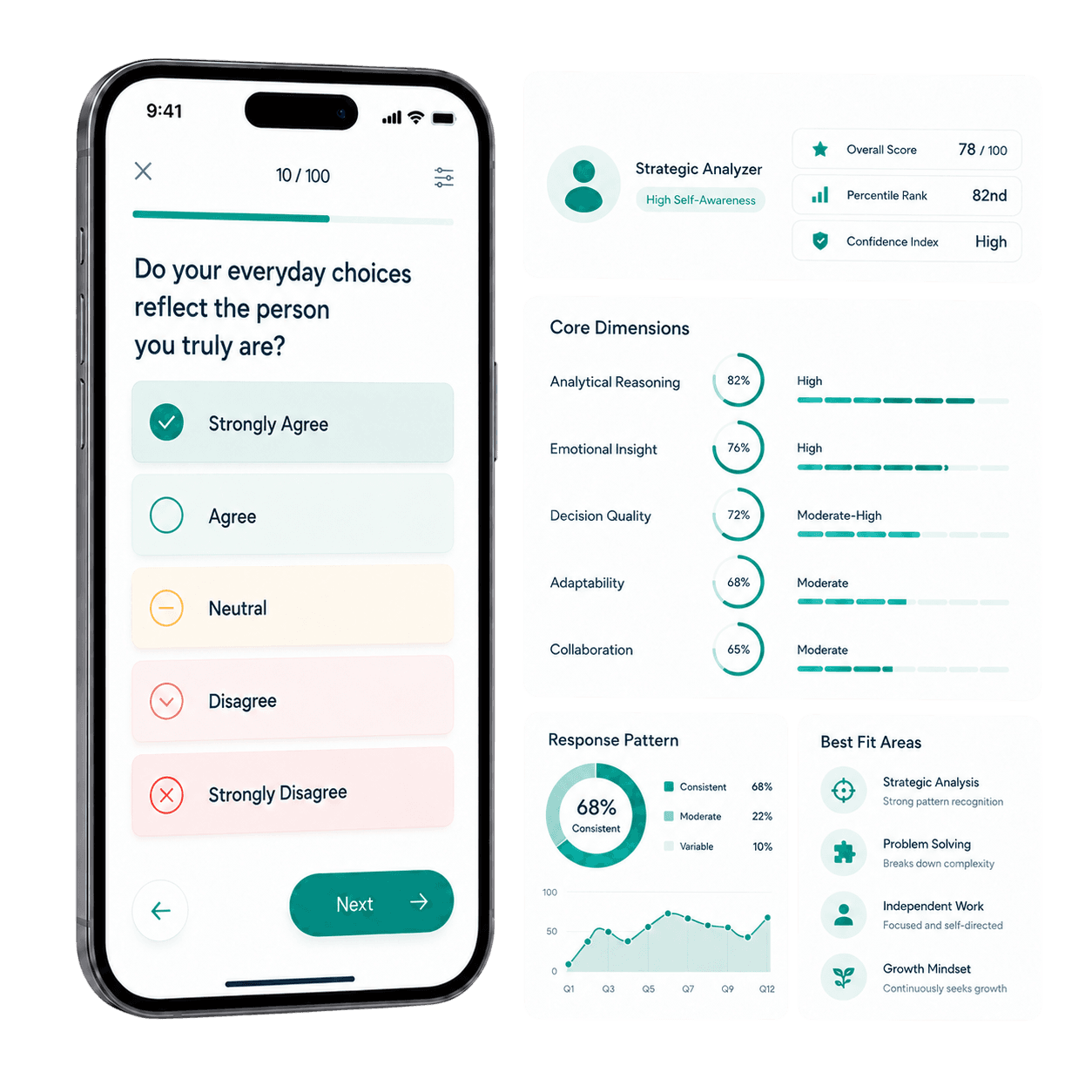
TestCore Anxiety Test and personalised report preview

Look at the whole anxiety pattern, not one difficult moment

The assessment covers the ways anxiety-related patterns can appear in thoughts, physical tension, social situations, uncertainty, and the choices you make to feel safer or more in control.

See what keeps your mind occupied

Notice whether possible problems, past conversations, decisions, or worst-case outcomes keep returning after more thinking has stopped being useful.

  • Recurring worry and mental replay
  • Difficulty switching attention away
  • The search for certainty before moving on

Track what uncertainty changes

Look at what happens when the outcome is unclear: whether tension rises, choices become harder, reassurance feels necessary, or ordinary situations start requiring more preparation than expected.

  • Pressure when answers are incomplete
  • How decisions change under uncertainty
  • What helps only briefly

Put the result back into real life

Your report adds context around stress, relationships, communication, work, and decision-making so the result is easier to compare with the situations you actually live through.

  • One overall anxiety-traits level
  • Context across daily functioning
  • Clearer language for what deserves attention

How it works

1

Answer from your usual experience

Think about recurring situations rather than one unusually calm or difficult day. Choose what is normally true when worry, pressure, uncertainty, or avoidance shows up.

2

Bring the different signals into one result

Your answers are combined into one overall anxiety-traits level rather than treated as isolated symptoms or separate clinical diagnoses.

3

Use the report to locate the real cost

Compare the result with your own life: where anxiety-related patterns take time, energy, confidence, sleep, attention, or freedom to act the way you want to.

Frequently asked questions

Q

What does the Anxiety Test measure?

The questionnaire looks at anxiety-related experiences across anxious thinking, physical tension, social situations, responses to uncertainty, and avoidance. Your answers are combined into one overall anxiety-traits level.

Q

Will I get separate anxiety-type scores?

No. TestCore does not return separate diagnostic subscale scores for different anxiety disorders. The assessment produces one overall result and a detailed report that helps you interpret it in context.

Q

Is this the GAD-7 or another clinical screener?

No. TestCore uses its own questionnaire. It does not provide a GAD-7 score and does not claim to be a validated clinical screening instrument.

Q

Is the Anxiety Test a diagnosis?

No. An online self-report cannot diagnose an anxiety disorder or establish why a pattern exists. A qualified professional can assess symptoms, history, context, and impact more fully.

Q

Can my result change over time?

Yes. Stress, circumstances, habits, support, and the situations you are dealing with can affect how strongly anxiety-related patterns appear in your answers. Treat the result as information about your current pattern, not a fixed identity.

Q

When should I consider professional support?

Consider speaking with a qualified health professional when anxiety is persistent, worsening, difficult to manage, or interfering with work, relationships, sleep, daily activities, or your sense of safety.

The pattern matters more than the single symptom

A racing mind, a tense body, a postponed task, and the urge to check one more time can feel like separate problems. The useful question is whether they repeatedly appear around the same need for certainty or safety.

See whether worry keeps reopening problems that are already as solved as they can be
Notice when uncertainty changes decisions, preparation, checking, or avoidance
Compare how well you function with how much mental effort that functioning requires
Use one overall result as a starting point for a more specific next conversation or decision
Start the anxiety test
Takes around 10 minutesPrivate and secure