
Testcore

See what sits behind the psychopath label when real choices have consequences.

A single adjective cannot tell you much. This assessment looks at a broader combination: how strongly other people's emotions register, how you use influence, what guilt or accountability changes, and how quickly risk or personal gain can outweigh later consequences.

Fast results
Secure
Private
Trusted by thousands of curious users
Rated 4.8/5by our users
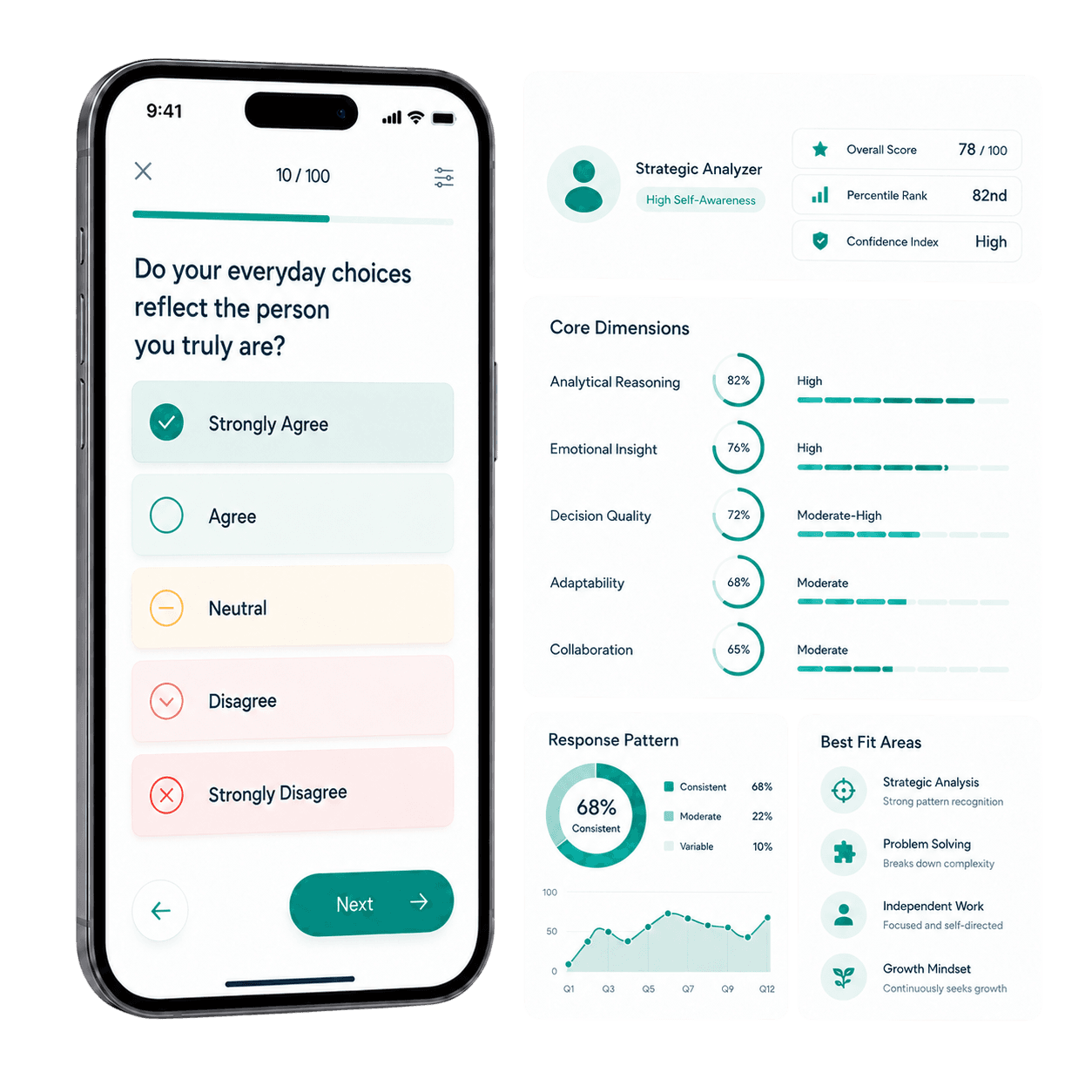
TestCore Psychopath Test and personalised report preview

The practical question is what the pattern changes in real life

Psychopathy-related traits are commonly discussed across emotional, interpersonal and behavioural domains. TestCore keeps the focus on what those tendencies do to choices, relationships, accountability and consequences rather than turning one trait into a verdict.

Track emotional distance into the next decision

Staying calm can be useful. Ask what happens when another person's distress should affect your choice: whether concern enters the calculation, whether emotional impact is easy to set aside, and whether that changes how you act.

  • How strongly another person's distress registers
  • Whether emotional impact changes the choice
  • Where composure becomes distance

Look at influence together with reciprocity

Social confidence and adaptability can solve problems. The pattern becomes more consequential when impression management, strategic presentation or persuasion repeatedly serves personal advantage while honesty or reciprocity becomes secondary.

  • What the interaction is trying to achieve
  • How much honesty and reciprocity matter
  • What happens to trust afterwards

Follow risk through to accountability

A high-stakes choice is not only about whether you take the risk. Notice how much time you give consequences before acting, what happens if someone else pays part of the cost, and whether regret or responsibility changes the next decision.

  • Speed versus consequence review
  • Who absorbs the cost
  • What changes after the outcome

How it works

1

Answer from ordinary decisions, not the stereotype

Use repeated examples from relationships, work, conflict, competition and responsibility. One unusually cold or reckless moment should not carry the whole result.

2

Bring emotional, interpersonal and risk themes together

Your responses produce one overall psychopathy-traits range. The value comes from seeing how several tendencies combine rather than treating each one as a separate diagnosis.

3

Use the result where consequences become visible

Compare the report with trust, responsibility, risk, conflict and the moments when your own goals compete with another person's needs. That is where a practical next step becomes clearer.

Frequently asked questions

Q

What does the Psychopath Test explore?

It covers themes such as emotional detachment, empathy and concern, responsibility, social influence, honesty, guilt and remorse, composure, risk-taking, impulsivity, self-interest and consequence awareness. The result combines them into one overall psychopathy-traits range.

Q

Will this test tell me whether I am a psychopath?

No. TestCore provides an educational self-report result, not a clinical diagnosis or a final judgment about your identity.

Q

Is this the PCL-R, LSRP or TriPM?

No. This assessment is not one of those named professional or research instruments and does not claim to reproduce their scoring or subscales.

Q

Do I receive separate scores for empathy, manipulation or impulsivity?

No. You receive one overall psychopathy-traits result. The report discusses relevant themes but does not provide dedicated numeric sub-scores for them.

Q

Can the result predict violence, crime or dangerousness?

No. An online self-report trait result cannot be used to predict criminal behaviour, violence or dangerousness.

Q

When is outside perspective useful?

If repeated behaviour is causing serious harm, aggression, deception, safety concerns or major relationship problems, qualified professional support can provide context and accountability an online assessment cannot.

A useful result should make the next decision easier to examine

The point is not to collect a harsher label. It is to identify where a recurring tendency changes empathy, trust, risk or accountability enough to matter in practice.

One overall psychopathy-traits result rather than a clinical diagnosis
Context for emotional distance, remorse, influence, risk and consequences
Specific situations where behaviour creates a cost or a strength
A private report you can compare with real examples before deciding what to change or discuss
Explore psychopathy-related patterns
Takes around 10 minutesPrivate and secure