Rules and consequences
See whether rules become optional when they block a goal, how much later consequences influence you, and whether responsibility changes your next decision.
- Rule disregard
- Consequence awareness
- Accountability

Sociopath is a popular term, not a formal diagnosis. This assessment focuses on the practical pattern underneath it: empathy and remorse, rules and boundaries, influence and honesty, impulse and risk, emotional distance, responsibility, and the consequences of your choices.
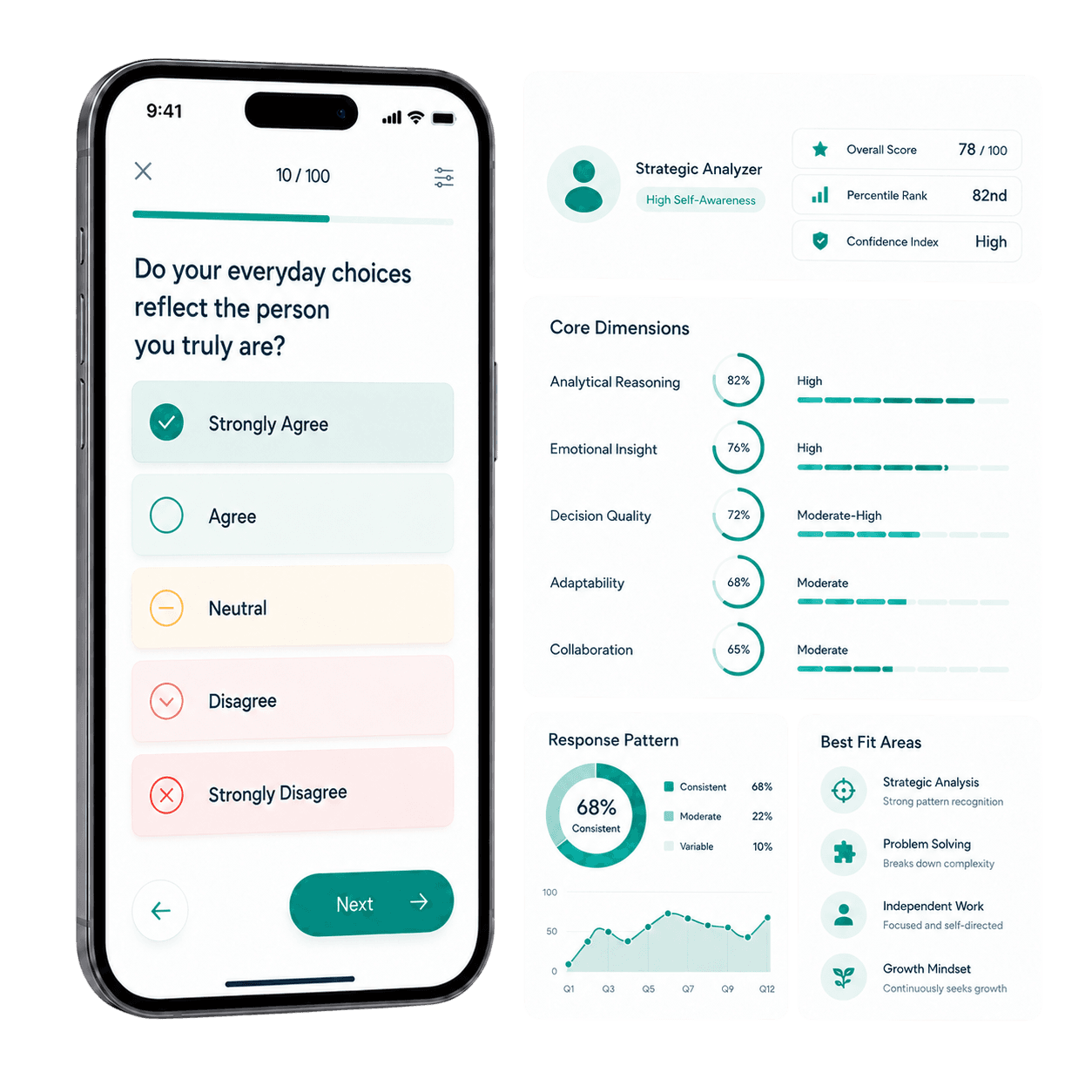
The test returns one overall sociopathic-traits level. Use it to locate the behavior that matters most in real life rather than treating a broad label as the conclusion.
See whether rules become optional when they block a goal, how much later consequences influence you, and whether responsibility changes your next decision.
Look at empathy, remorse, honesty, persuasion, emotional distance, and whether other people's needs remain part of the calculation when stakes rise.
Identify whether fast action, risk, or self-interest repeatedly creates costs you can predict — and choose the next behavior worth changing or discussing.
Use what is typical across relationships, work, rules, commitments, conflict, and high-stakes choices rather than one extreme incident.
Your answers produce one Level 1–5 sociopathic-traits result rather than separate scores for empathy, impulse, rule-breaking, manipulation, or risk.
Use the report to decide whether accountability, boundaries, impulse control, honesty, empathy, or consequence awareness deserves attention first.
No. Sociopath is a lay term. Antisocial personality disorder is a formal diagnosis that requires professional assessment and developmental history beyond an online questionnaire.
You receive one overall Level 1–5 sociopathic-traits result with a report that discusses the wider pattern in everyday terms.
No. It cannot establish antisocial personality disorder or required childhood history.
No. It does not predict dangerousness, violence, criminality, or moral character.
No. TestCore uses its own questionnaire and scoring and should not be treated as equivalent to those instruments or a clinical diagnostic assessment.
If recurring behavior involves aggression, exploitation, legal problems, repeated harm, or loss of control, professional assessment and real-world support are more important than another online test.
A broad label does not tell you what to do next. A specific recurring behavior can.