Testcore

See what happens after you notice someone else's emotion

Empathy can mean understanding a viewpoint, feeling another person's emotion, spotting a social cue or stepping in to help. The useful question is which reactions come naturally to you — and where they begin to cost clarity, energy or boundaries.

Fast results
Secure
Private
Trusted by thousands of curious users
Rated 4.8/5by our users
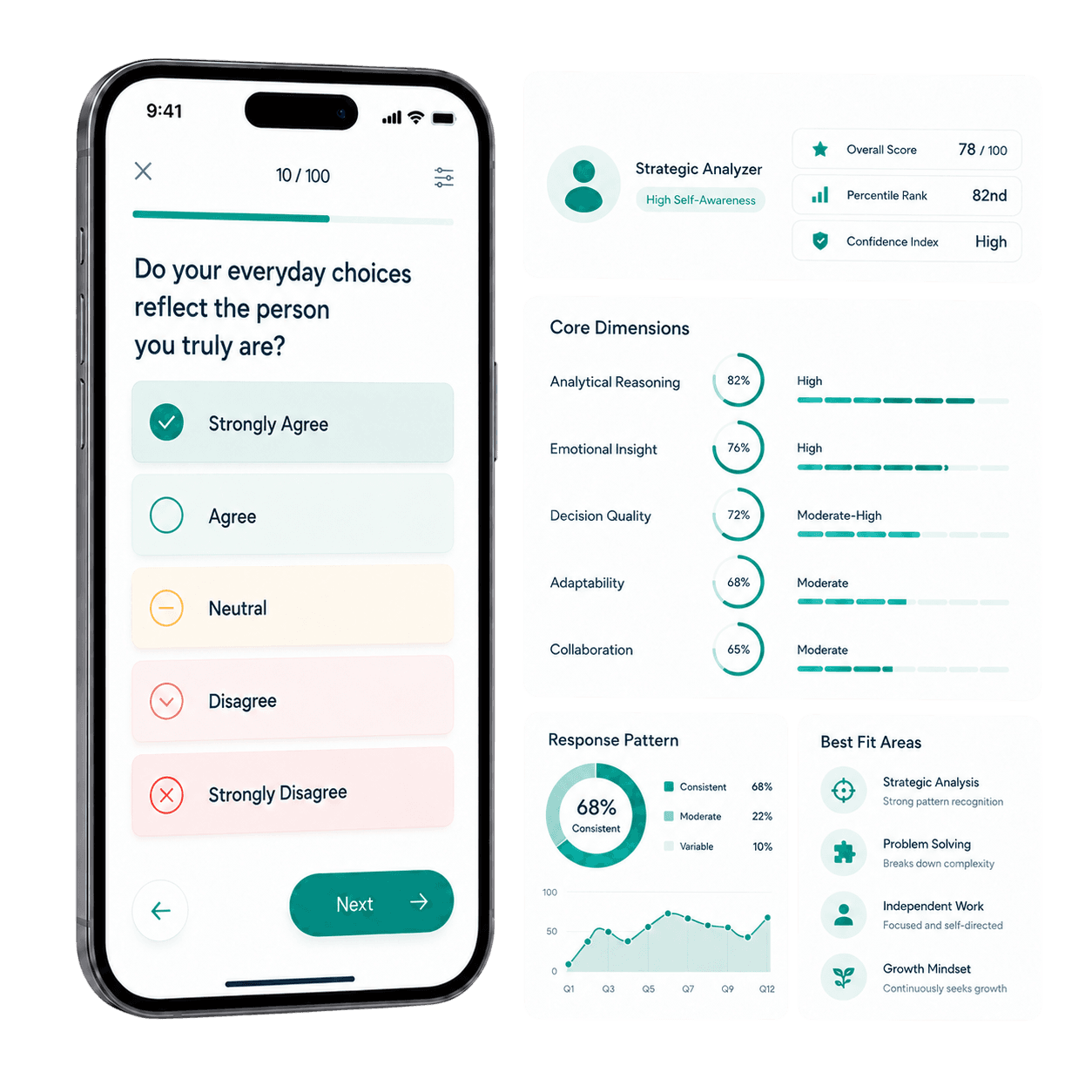
TestCore Empathy Test and personalised report preview

Break empathy into the parts that change real interactions

The test brings together understanding, emotional sensitivity, compassion, social reading, helping and boundaries so you can see more than a single high-or-low label.

Read the signal before the story

Notice whether you pick up tone, mood and social cues — and how quickly you turn those signals into an assumption about what another person feels or wants.

  • Emotional and social cues
  • Perspective-taking
  • Assumption checking

Separate understanding from emotional absorption

You can understand someone without feeling their emotion intensely, or feel it intensely without knowing what would actually help. The difference matters.

  • Cognitive empathy
  • Emotional resonance
  • Sensitivity and overload

Turn care into a response you can sustain

See how compassion, helping and boundaries interact so support does not quietly become over-responsibility or emotional exhaustion.

  • Compassionate action
  • Helping behavior
  • Emotional boundaries

How it works

1

Answer from everyday situations

Think about conversations, other people's distress, disagreement, emotional environments and the moments when someone expects support.

2

See your overall empathy range

Your responses are brought together into a broad empathy result that reflects how often empathy-related tendencies show up across the assessment.

3

Use the report where the pattern matters

Take the result into relationships, conflict, teamwork, leadership and the situations where another person's emotions change what you do next.

Frequently asked questions

Q

What does the Empathy Test explore?

It reflects self-reported tendencies in emotional sensitivity, understanding other perspectives, social reading, compassion, helping behavior and emotional boundaries.

Q

What is the difference between cognitive and emotional empathy?

Cognitive empathy is understanding another person's viewpoint or emotional state. Emotional empathy is feeling affected by what they feel. You can be stronger in one than the other.

Q

Is high empathy always an advantage?

No. Empathy can strengthen relationships, but strong emotional absorption without boundaries can also become exhausting. The report is most useful when you look at both strengths and costs.

Q

Can empathy change with stress or context?

Yes. Trust, conflict, role, energy and stress can all change how easily you understand, feel with or support another person.

Q

Is the Empathy Test a diagnosis?

No. It is an educational self-reflection assessment, not a medical, psychological or psychiatric diagnosis.

Q

How should I use the result?

Use it to notice a specific pattern earlier — an assumption, a helping reflex, emotional overload or a boundary problem — and choose a more deliberate response the next time it appears.

Empathy is useful when it improves the next interaction

A practical result should help you notice what you read well, where emotion changes your judgment and when support needs a boundary.

Understanding another viewpoint without assuming agreement
Recognising the difference between empathy and emotional contagion
Supporting someone without taking ownership of their feelings
Using boundaries to keep care sustainable
Take the empathy test
Takes around 10 minutesPrivate and secure