Testcore

See where doubt turns into a cycle that keeps asking for another response.

An intrusive thought or unresolved doubt can pull attention in. Checking, repeating, reviewing or following a routine can reduce the discomfort — but only briefly. This OCD test helps you examine that practical sequence and its impact.

Fast results
Secure
Private
Trusted by thousands of curious users
Rated 4.8/5by our users
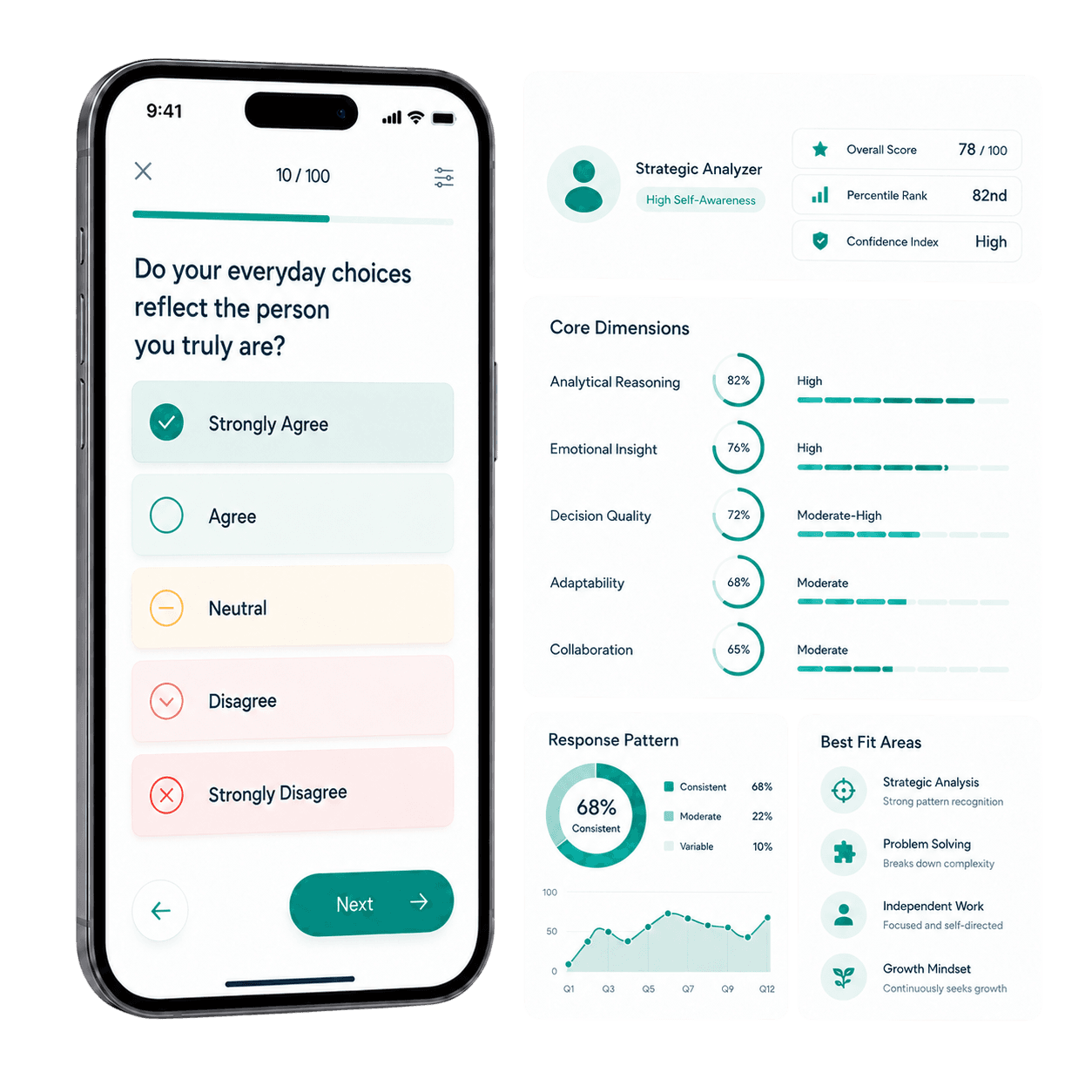
TestCore OCD Test and personalised report preview

Understand the loop before it quietly takes more of your day

The assessment covers intrusive thoughts, rumination, checking, repetitive responses, routines, certainty-seeking and the relief that can reinforce repetition. It is a self-reflection tool, not a diagnosis.

Find the point where attention gets stuck

Notice the thought, doubt, unfinished feeling or responsibility that becomes difficult to leave unresolved.

  • Recurring or intrusive thoughts
  • Uncertainty that feels urgent
  • The situations that hold your attention

Trace the response that follows

Look at checking, reassurance, repetition, mental review or routines and ask what they are trying to accomplish in the moment.

  • What you do next
  • What relief the response creates
  • How quickly the doubt returns

Measure the practical cost

Use the report to identify where the pattern is consuming extra time, delaying decisions, draining mental energy or making ordinary tasks harder to leave finished.

  • Time and attention
  • Decision-making
  • Daily flexibility

How it works

1

Answer from the cycles you actually recognise

Think about repeated thoughts, checking, routines and moments when you know something is probably fine but still feel pulled to resolve it again.

2

Connect trigger, response and relief

Your answers are read together so you can see how uncertainty, the response used to reduce it and the after-effect may relate across situations.

3

Use the result to choose a useful next step

Take the reflection into the places where the pattern costs the most time or energy, and consider professional support when distress or interference is significant.

Frequently asked questions

Q

What does the OCD Test explore?

It explores self-reported patterns involving intrusive or recurring thoughts, rumination, checking, repetitive actions, routines, certainty-seeking and the difficulty of moving on when something feels unresolved.

Q

Will the test diagnose OCD?

No. TestCore does not diagnose obsessive-compulsive disorder. A qualified mental-health professional is needed for clinical assessment.

Q

Will I get separate scores for obsessions and compulsions?

No. The assessment returns one overall result range and uses several themes to help explain it in context.

Q

Why does the result focus on relief as well as the thought?

A response that reduces discomfort temporarily can become more compelling the next time uncertainty appears. Looking at the before-and-after sequence can make a recurring loop easier to recognise.

Q

What if my result does not match every OCD stereotype?

That is not unusual. Obsessive-compulsive experiences are not limited to cleanliness or visible rituals. Compare the report with your own repeated thoughts, mental routines, checking and responses to uncertainty.

Q

When should I consider professional support?

Consider qualified support if intrusive thoughts, compulsive responses or repeated checking are persistent, distressing or interfering with daily life. An online result is not a replacement for care.

The useful question is what the cycle is doing to your time, attention and choices.

A self-check cannot establish OCD. It can help you describe the sequence you are experiencing and recognise where repeated attempts to feel certain may be creating a practical cost.

Identify the thought or doubt that starts the loop
See the response used to reduce discomfort
Notice whether relief lasts or renews the need to respond
Use clearer language for reflection or a professional conversation
Explore OCD-related patterns
Takes around 10 minutesPrivate and secure