
Testcore

Find the best-fit Enneagram type when more than one sounds familiar.

Several types can share the same visible behaviour. TestCore compares the full answer pattern across all nine so the result is based on more than one trait, one role or one memorable situation.

Fast results
Secure
Private
Trusted by thousands of curious users
Rated 4.8/5by our users
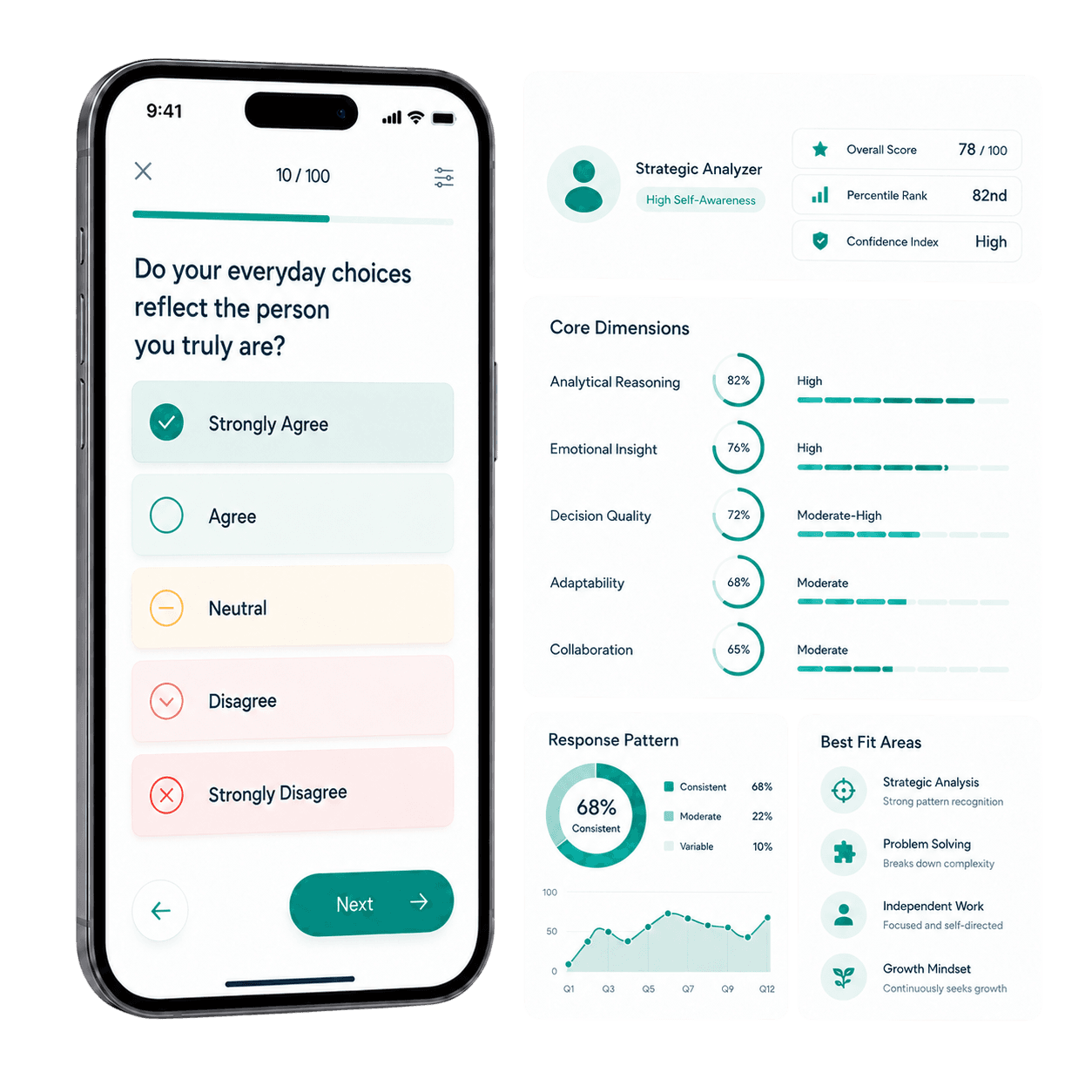
TestCore Enneagram Type Test and personalised report preview

Look-alike types become easier to compare when you focus on why

The same behaviour can serve different motives. The report gives you a dominant type to compare with the reasons, fears and situations behind your recurring responses.

Compare similar behaviour more carefully

Helping, planning, achieving, withdrawing or avoiding conflict can appear in several types. The motivation beneath the behaviour is often the more useful distinction.

  • Surface behaviour
  • Underlying motivation
  • Recurring fear or priority

Check the result across settings

A stronger fit should remain useful when you compare relationships, work, decisions and pressure rather than depending on one example.

  • Relationships
  • Work and responsibility
  • Stress and uncertainty

Keep the result proportional

Use the dominant type as a focused hypothesis. If parts of the report do not fit, keep that mismatch in the picture rather than forcing the label.

  • One best-fit result
  • Room for disagreement
  • No wing or subtype output

How it works

1

Answer for what is usually true

Rate 100 statements across normal life rather than answering only from one role, relationship or unusually difficult period.

2

Let all nine types compete

Your responses are normalised across nine Enneagram patterns. The highest overall match becomes the dominant type.

3

Check the why behind the result

Use the complete report to compare its motivations and fears with relationships, work, stress and growth before deciding how well the type fits.

Frequently asked questions

Q

Why do I recognise myself in several Enneagram types?

Different types can share visible traits and habits. The assessment compares the overall pattern in your answers, while the report gives you motivations and fears to examine for a deeper fit.

Q

How does TestCore choose my dominant type?

The 100 responses contribute to normalised scores across Types 1–9. The highest score becomes the dominant result, using the assessment's fixed tie-breaker if needed.

Q

Should I answer as the person I want to be?

No. Answer for what is usually true, including patterns you may want to change. Ideal-self answers can make the result harder to interpret.

Q

Does this test calculate my Enneagram wing?

No. TestCore identifies one dominant type and does not calculate wings, instinctual subtypes or tritypes from this questionnaire.

Q

What if I think another type fits better?

Compare both explanations with concrete examples, especially their underlying motivations and fears. The questionnaire gives a best-fit result, not an identity you are required to adopt.

Q

Is an Enneagram type a diagnosis?

No. It is part of an educational personality framework used for self-reflection, not a medical or psychological diagnosis.

A good type fit should explain more than one familiar trait.

The result becomes more useful when the same underlying motive helps make sense of several situations, not when one flattering sentence happens to sound right.

Nine type patterns compared from the same questionnaire
One dominant type result
Motivations and fears for deeper comparison
No wing, subtype or tritype calculated
Find your Enneagram type
Takes around 10 minutesPrivate and secure