Testcore

See the conditions where your work gets better before you blame effort for a bad fit.

Some people do their best work with structure and visible progress. Others need deep analysis, constant interaction, creative freedom, or room to lead. Your result shows which career pattern is strongest and what that suggests about your working style.

Fast results
Secure
Private
Trusted by thousands of curious users
Rated 4.8/5by our users
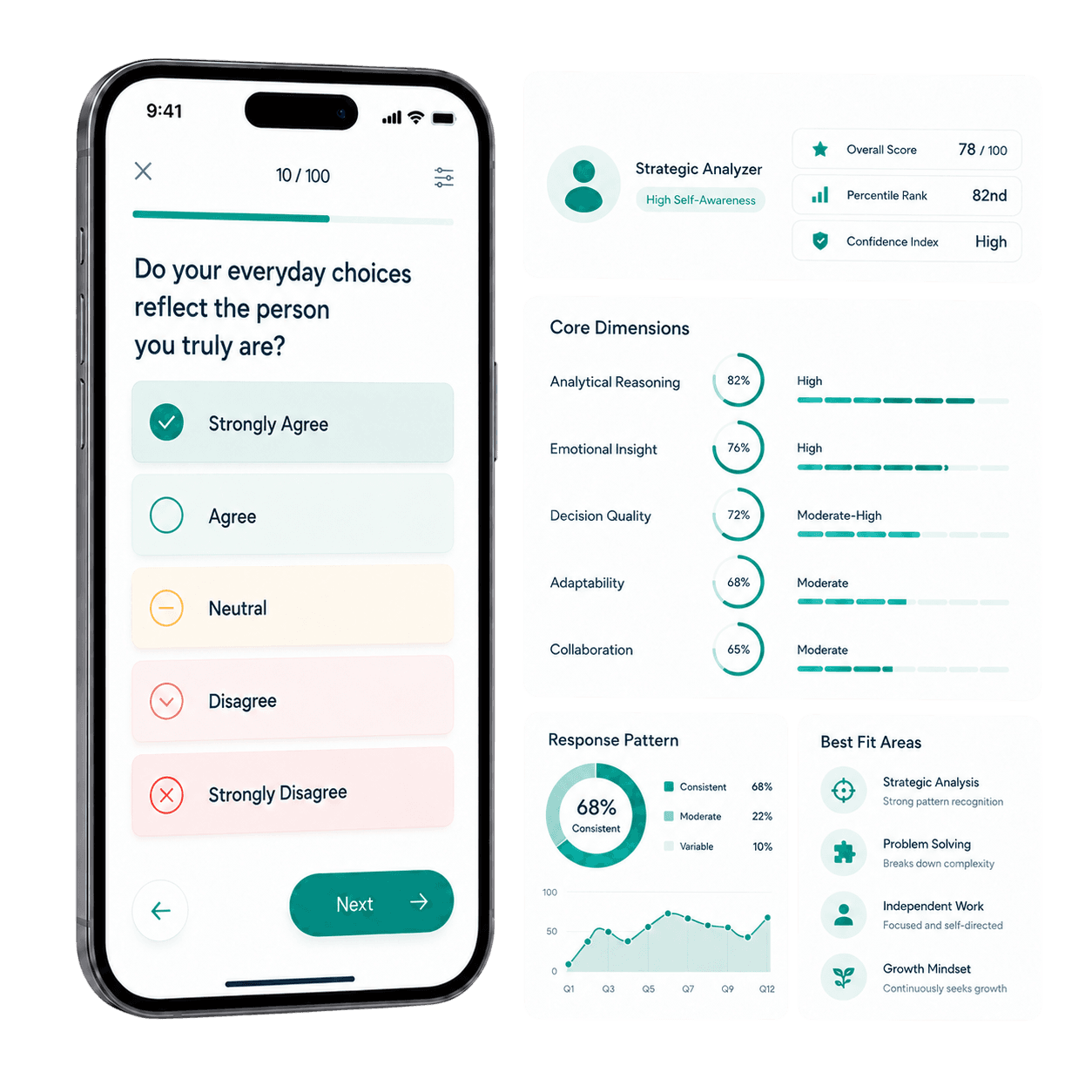
TestCore Work Style Test and personalised career-type report preview

Work style is the way your strengths meet the environment

This page focuses on the daily conditions around your dominant career type: how you approach problems, structure, collaboration, decisions, ownership, and change.

Understand how you prefer to approach the work

Your career type highlights a recurring mode of contribution—execution, analysis, communication, creativity, or leadership—that influences how you tackle a normal workday.

  • How you start and organize work
  • The problems that hold your attention
  • The kind of progress that motivates you

See which conditions change your performance

Structure, autonomy, collaboration, feedback, ambiguity, pace, and responsibility can make the same person look highly effective in one role and constantly strained in another.

  • How much structure helps
  • How you prefer to work with people
  • Where autonomy or direction matters

Use the insight to shape the environment

You may not need a new career to improve fit. Sometimes the useful move is a different project, clearer ownership, more independent time, a new team, or a role with a better mix of responsibilities.

  • Changes you can test in your current role
  • Questions to ask about a future role
  • A clearer reason for why some environments work better

How it works

1

Think about environments where your performance changed

Use examples from teams, projects, managers, deadlines, and different levels of autonomy to see what is consistently true about the way you work.

2

Identify your dominant career type

Your answers are compared across Builder, Analyst, Communicator, Creator, and Leader patterns, with the strongest one becoming the basis of the report.

3

Translate the type into work-style criteria

Use the report to decide which conditions you want to preserve, negotiate, or investigate when you think about projects, teams, and future roles.

Frequently asked questions

Q

Does the Work Style Test give me a separate work-style score?

No. It uses the Career Test and returns one dominant career type. This page interprets that type through the lens of day-to-day working conditions and preferences.

Q

What work styles are included?

The five career types are Builder, Analyst, Communicator, Creator, and Leader. Each represents a different broad way of creating value at work rather than a rigid personality category.

Q

Can my work style change depending on the job?

Context matters. A person can adapt to different environments, and skills develop over time. The result is best treated as a strong pattern in your current answers rather than a fixed rule about how you must work.

Q

Can this help me improve my current job without leaving?

It can give you language for changes worth testing, such as clearer priorities, different project ownership, more focus time, more collaboration, more autonomy, or responsibilities that use your strongest contribution more often.

Q

How is work style different from career fit?

Work style focuses on how you prefer to operate day to day. Career fit compares that pattern with a particular role and environment. The two ideas overlap, but they answer different questions.

Q

Should I avoid jobs that do not perfectly match my style?

No. Every job involves adaptation and trade-offs. The report is useful for spotting major mismatches and asking better questions, not for eliminating any role that contains uncomfortable tasks.

Sometimes the career problem is really a work-environment problem

If the same type of task feels easy in one team and exhausting in another, the difference may be structure, autonomy, pace, communication, or ownership—not your ability to do the work.

One dominant career type interpreted through work style
Conditions that support or suppress the pattern
Changes worth testing before assuming the career is wrong
Questions to carry into your next role search
Discover your work style
Takes around 10 minutesPrivate and secure