
Testcore

See what happens when you have to act before you can feel certain about the outcome.

Some situations are hard because they demand a lot. Others become hard mainly because the answer is unclear, the plan can change, or no amount of preparation can guarantee what happens next. This test looks at that pressure in the wider context of anxiety.

Fast results
Secure
Private
Trusted by thousands of curious users
Rated 4.8/5by our users
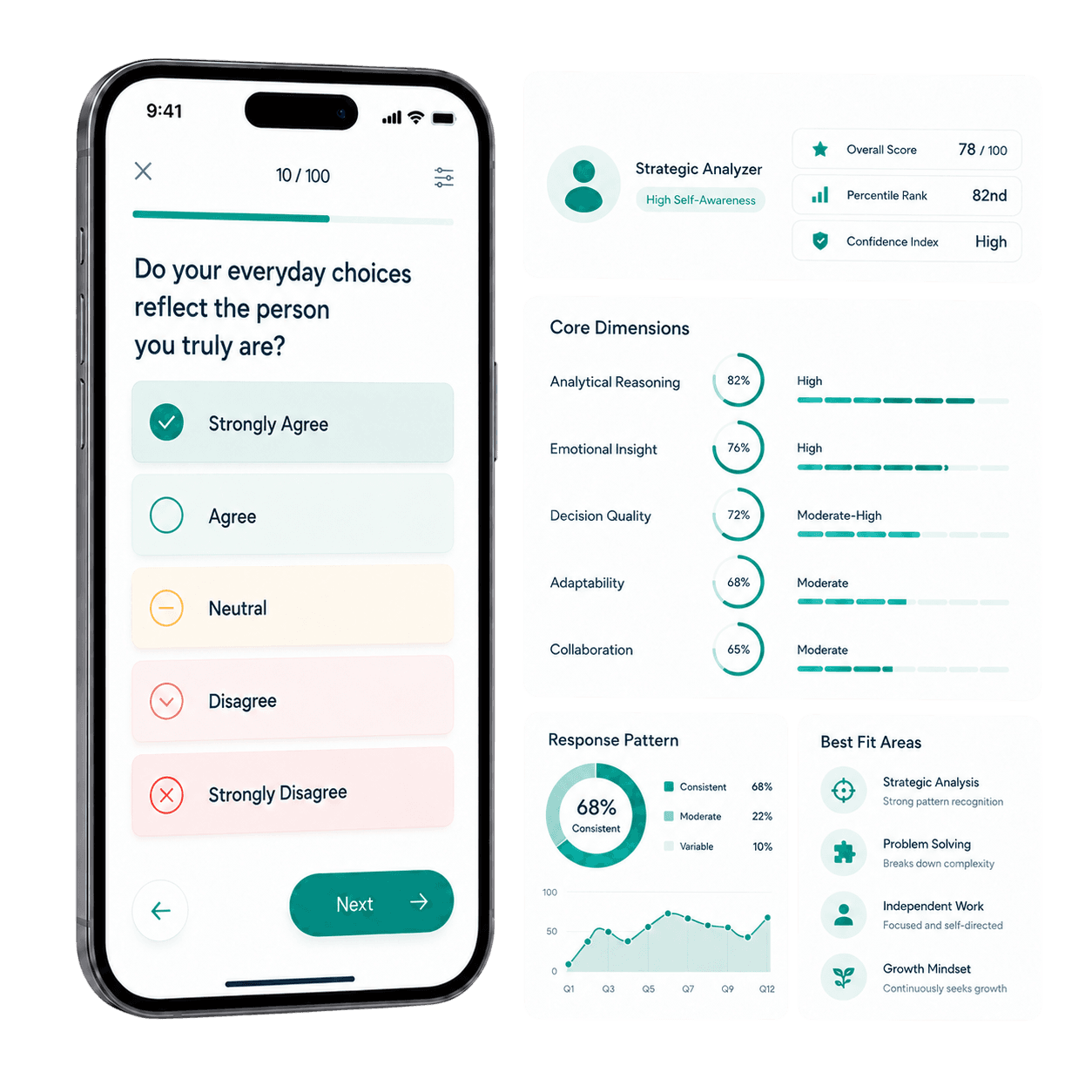
TestCore Stress and Uncertainty Test and personalised report preview

Find out whether uncertainty is the part that raises the pressure

The workload may not be the whole problem. Waiting, ambiguity, changing plans, and decisions with incomplete information can create a different kind of strain — one driven by not knowing.

Notice the urge to predict everything first

Look at whether your mind starts generating scenarios, researching beyond what is useful, or rehearsing outcomes in an attempt to remove uncertainty before you move.

  • How much information feels like enough
  • Whether possibilities multiply under pressure
  • When preparation becomes a search for certainty

See how uncertainty changes behaviour

Consider whether unclear outcomes lead you to delay, avoid, check, ask for reassurance, over-plan, or keep decisions open longer than the situation requires.

  • Delay and indecision
  • Checking or reassurance habits
  • Avoidance when outcomes cannot be controlled

Separate stress from the need for control

Your report helps you compare demanding situations with uncertain ones and see whether anxiety-related patterns become stronger specifically when control or predictability drops.

  • What pressure actually triggers the pattern
  • How much uncertainty affects daily choices
  • Where flexibility becomes harder

How it works

1

Answer from situations where the outcome is unclear

Think about waiting, changing plans, ambiguous messages, open-ended decisions, or responsibilities where you cannot guarantee the result before you begin.

2

See uncertainty inside the full anxiety result

The questionnaire combines your responses with other anxiety-related experiences across thinking, tension, social situations, and avoidance. It does not return a separate intolerance-of-uncertainty score.

3

Locate the point where control becomes costly

Use the report to notice when preparation is useful and when the attempt to remove uncertainty starts consuming more time, energy, or freedom than the situation itself.

Frequently asked questions

Q

What does stress from uncertainty look like?

It can show up as repeated scenario-planning, difficulty making decisions without complete information, checking, reassurance-seeking, over-preparing, or avoiding situations whose outcome cannot be guaranteed.

Q

Is uncertainty the same as stress?

No. Stress can come from workload, conflict, time pressure, or many other demands. This page focuses on situations where not knowing, not controlling, or not being able to predict the outcome appears to add a significant part of the pressure.

Q

Will I get an uncertainty score?

No. TestCore provides one overall anxiety-traits level. Questions related to uncertainty contribute to that broader result rather than producing a separate clinical or intolerance-of-uncertainty subscore.

Q

Can wanting certainty ever be useful?

Of course. Planning, checking important facts, and reducing avoidable risk can be sensible. The useful distinction is whether the search for certainty improves the decision or keeps expanding after enough information is already available.

Q

Is the Stress and Uncertainty Test a diagnosis?

No. It is an educational self-report and cannot diagnose an anxiety disorder or determine the cause of your response to uncertainty.

Q

When should I consider additional support?

Consider professional support if anxiety around uncertainty is persistent, difficult to manage, or substantially interfering with work, relationships, sleep, daily activities, or safety.

The hardest part of a situation may be the part you cannot know in advance

Two tasks can require the same effort but feel completely different when one has a predictable outcome and the other does not. That difference is worth noticing.

Compare demanding situations you handle well with uncertain situations that create disproportionate pressure
Notice whether more information actually improves the decision or mainly postpones having to act without certainty
Track the relief from checking, reassurance, or avoidance and whether the same uncertainty returns afterwards
Use the overall anxiety result to see whether uncertainty is one part of a broader pattern rather than the whole explanation
Test your uncertainty response
Takes around 10 minutesPrivate and secure