Trust and reciprocity
Notice whether relationships feel mutual or mainly useful, how you respond when someone depends on you, and whether promises still matter when keeping them becomes inconvenient.
- Trust
- Reciprocity
- Commitments

If you are looking for a generic communication style, extroversion profile, or social-skills type, this is not that test. This broader sociopathic-traits assessment focuses on empathy, trust, reciprocity, influence, commitments, rules, boundaries, and how your choices affect other people.
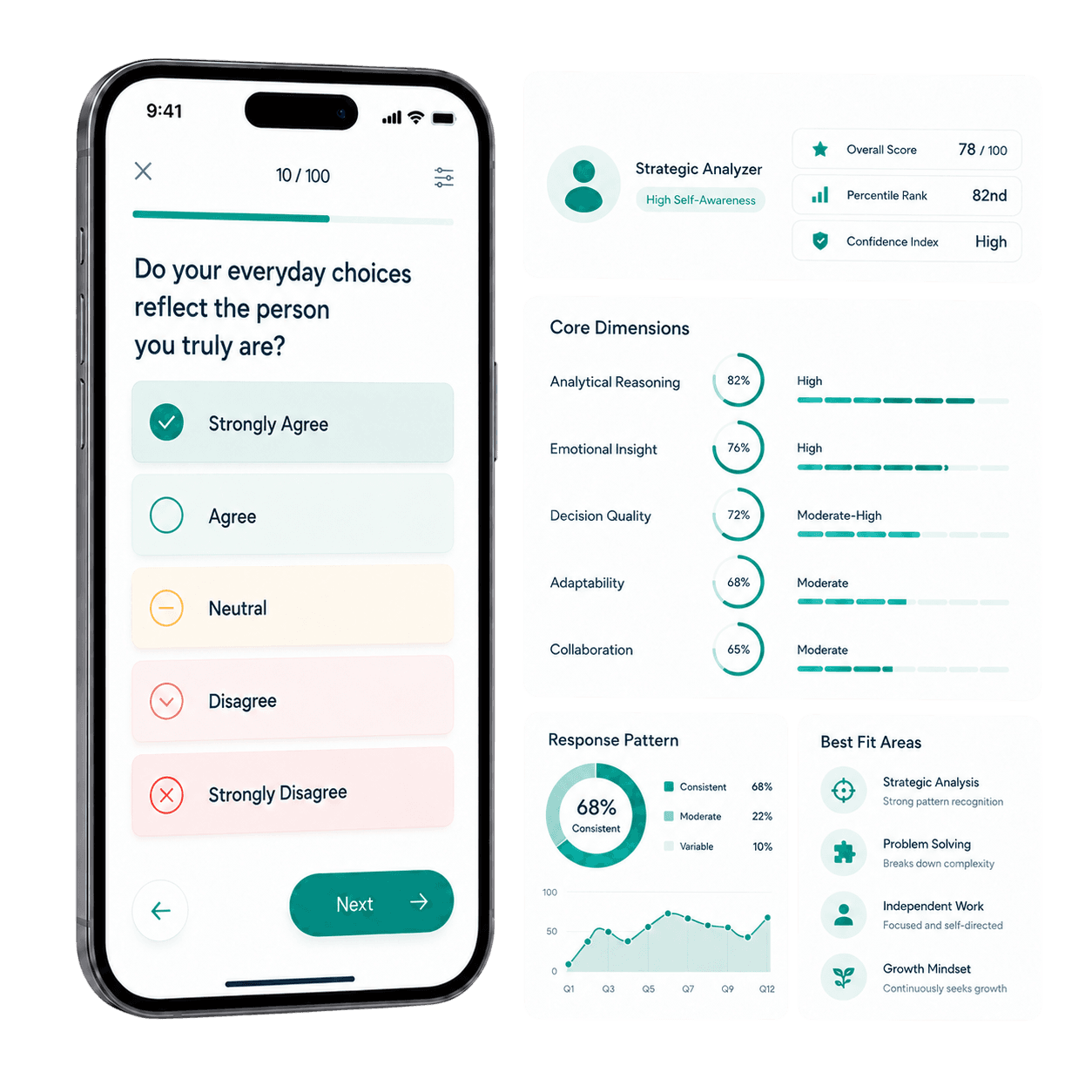
You receive one overall sociopathic-traits result. This route narrows attention to how the broader pattern appears in commitments, trust, influence, empathy, boundaries, and responsibility.
Notice whether relationships feel mutual or mainly useful, how you respond when someone depends on you, and whether promises still matter when keeping them becomes inconvenient.
Look at persuasion, strategic self-presentation, honesty, respect for limits, and whether another person's boundary remains meaningful when it blocks your preferred outcome.
The practical test of a social pattern is what happens after harm, conflict, or disappointment: accountability, repair, blame, justification, or repeated behavior.
Think about close relationships, work, promises, groups, conflict, boundaries, and situations where another person's interests compete with your own.
Your answers produce one Level 1–5 sociopathic-traits result. There is no named social style, communication type, or dedicated social-behaviour score.
Use the report to identify whether trust, boundaries, honesty, empathy, reciprocity, or accountability deserves the most practical attention.
No. It is a broader sociopathic-traits assessment viewed through social behavior. It does not assign a communication style, extroversion type, or social-skills category.
No. You receive one overall Level 1–5 sociopathic-traits result.
Themes include empathy, emotional distance, trust, honesty, influence, reciprocity, rules, boundaries, responsibility, remorse, and awareness of consequences.
No. Social conflict or detachment can have many explanations. Antisocial personality disorder requires a persistent broader pattern and professional assessment.
A dedicated communication or interpersonal-style assessment would be a better fit. This page is specifically about social behavior as part of a broader sociopathic-traits pattern.
No. It is based on your own answers and cannot diagnose or reliably label someone else.
Who needs what, which boundary appears, what you choose, who carries the cost, and what happens afterward are more useful than a vague social-style label.