Testcore

Find out what social and sensory load is costing you before the crash makes it obvious.

A conversation, crowded room, bright office or layered stream of sounds can be manageable in the moment and still use up far more capacity than anyone sees. This page focuses on that hidden load and what happens afterwards.

Fast results
Secure
Private
Trusted by thousands of curious users
Rated 4.8/5by our users
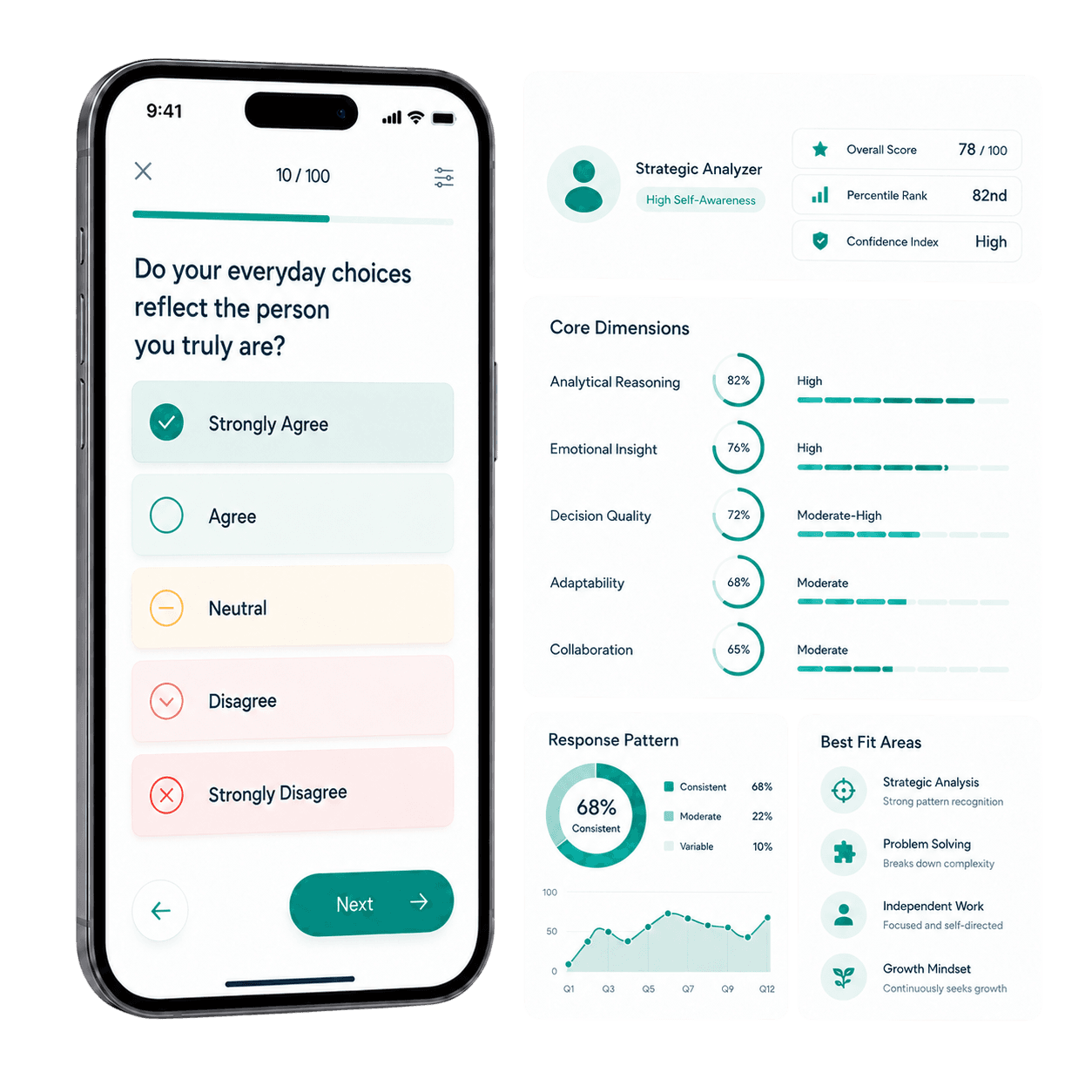
TestCore Social and Sensory Patterns Test and personalised report preview

Capacity often disappears before performance does

The underlying autism questionnaire is broader than social and sensory experience alone. This route uses those two pressure points to examine how environment, communication and recovery fit into the wider pattern.

Separate social contact from social cost

Enjoying people does not mean every social setting is easy. Compare one-to-one and group interaction, direct and ambiguous communication, familiar and unfamiliar people, and how much active interpretation each requires.

  • Which interactions feel easiest
  • Where conscious monitoring increases
  • How much recovery follows

Track sensory load before it becomes overload

Noise, light, textures, movement and multiple inputs can accumulate. The important question is not only whether you tolerated them, but what they did to focus, comfort, communication and energy.

  • The input that builds up
  • What becomes harder first
  • How long the after-effect lasts

Use the result to change the environment, not blame yourself

The report can help you identify conditions worth adjusting: quieter space, clearer communication, recovery time, predictable plans or fewer simultaneous demands. These are practical experiments, not proof of diagnosis.

  • Reduce avoidable load
  • Protect recovery time
  • Test which supports actually help

How it works

1

Answer from situations with different levels of load

Think about quiet and crowded settings, one-to-one and group conversations, familiar and unfamiliar environments, and what happens after a demanding day.

2

Get the broader autism-traits result

This route uses TestCore's full autism self-report. It does not return separate social-load, sensory-sensitivity or recovery scores.

3

Read the result against your energy pattern

Use the report to compare where social and sensory demands overlap, which conditions make them easier and how much capacity you need afterwards to feel like yourself again.

Frequently asked questions

Q

Does being socially tired mean I am autistic?

No. Social fatigue can have many explanations. This page is useful when you want to compare it with a wider pattern that also includes communication, sensory experience, routine, change and other longstanding traits.

Q

Will I get separate social and sensory scores?

No. TestCore returns one overall autism-traits level and a detailed report. It does not provide independent numerical social or sensory subscores.

Q

Can sensory sensitivity affect communication or focus?

Yes. When several inputs compete at once, it can become harder to process conversation, regulate attention or stay comfortable. The same environment can also affect people very differently.

Q

What if I can tolerate an environment but need a long time to recover?

Include the recovery cost. Coping through a situation and finding it easy are not the same thing, and the after-effect can be an important part of the pattern you are trying to understand.

Q

Is this a validated autism screener?

No. TestCore uses its own self-report questionnaire and should not be interpreted as an AQ, RAADS-R or another validated clinical screening score.

Q

Can this test diagnose autism?

No. A professional assessment is needed to consider developmental history, persistent patterns across settings, daily impact and alternative explanations in full context.

Recovery is part of the data, not an afterthought

A situation can look manageable while it is happening and still consume the rest of the day. Tracking the after-effect can reveal social and sensory costs that performance alone hides.

Compare social desire with social effort
Track sensory load before obvious overload
Include recovery time in the pattern
Test environmental changes before turning the difficulty into self-blame
See your social and sensory pattern
Takes around 10 minutesPrivate and secure