When the rule feels optional
Notice whether rules lose importance mainly when they slow you down, block personal gain, feel pointless, or cannot be enforced.
- Rule respect
- Private behavior
- Personal gain

Questioning a bad rule is not the same as disregarding rules whenever they are inconvenient. This broader sociopathic-traits assessment looks at rule respect, private rule-following, boundaries, personal gain, impulse, risk, and whether consequences change later choices.
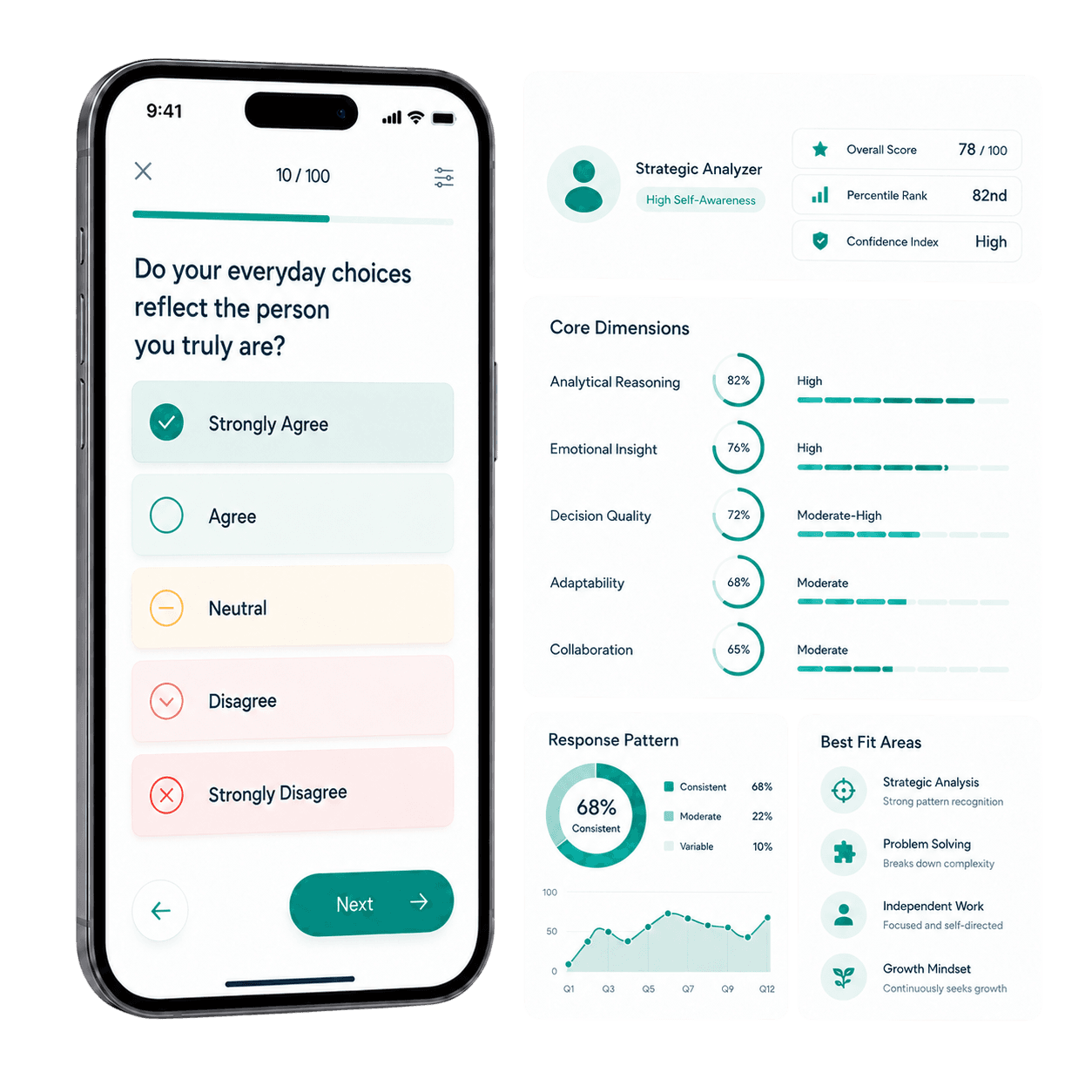
The result is one overall sociopathic-traits level, not a dedicated rule-breaking score. The practical value is understanding why rules become optional and what follows.
Notice whether rules lose importance mainly when they slow you down, block personal gain, feel pointless, or cannot be enforced.
Compare your response to formal rules with the limits other people set. Disregarding a boundary because it is inconvenient can reveal a different cost than disagreeing with a policy.
Ask whether predictable fallout, lost trust, penalties, or harm alter future behavior or whether the same calculation repeats when another opportunity appears.
Think about situations where nobody was watching, a shortcut benefited you, or another person's boundary stood between you and a goal.
Your answers contribute to one Level 1–5 sociopathic-traits result. There is no separate rule-breaking score and the result is not a measure of criminality.
Use the report to decide whether the practical issue is impulse, personal gain, boundary respect, consequence awareness, or responsibility after the fact.
No. Rule-related questions contribute to one overall Level 1–5 sociopathic-traits result rather than a dedicated sub-score.
No. Rule-breaking can occur for many reasons. Antisocial personality disorder requires a persistent broader pattern and professional assessment, including developmental history.
No. The reason, method, consequences, respect for others' rights, and broader pattern all matter. Disagreement with a rule is not automatically an antisocial trait.
No. It does not assess criminality or predict whether you will commit an offence.
Private behavior can help distinguish rule-following driven mainly by enforcement from rule-following based on values, consequences, or respect for other people.
Identify the recurring rule or boundary situation with the clearest real-world cost and examine the decision before, during, and after it rather than treating the score as a label.
A rule can be wrong, inconvenient, or unenforced. The useful distinction is whether disregard becomes a self-serving pattern that repeatedly ignores boundaries and predictable consequences.