
Testcore

See what you bring into closeness before another relationship starts carrying the same assumptions.

You cannot control another person's availability, honesty or consistency. You can get clearer on your own expectations: what makes trust easier, what makes distance feel dangerous, when you ask directly and when protection takes over instead.

Fast results
Secure
Private
Trusted by thousands of curious users
Rated 4.8/5by our users
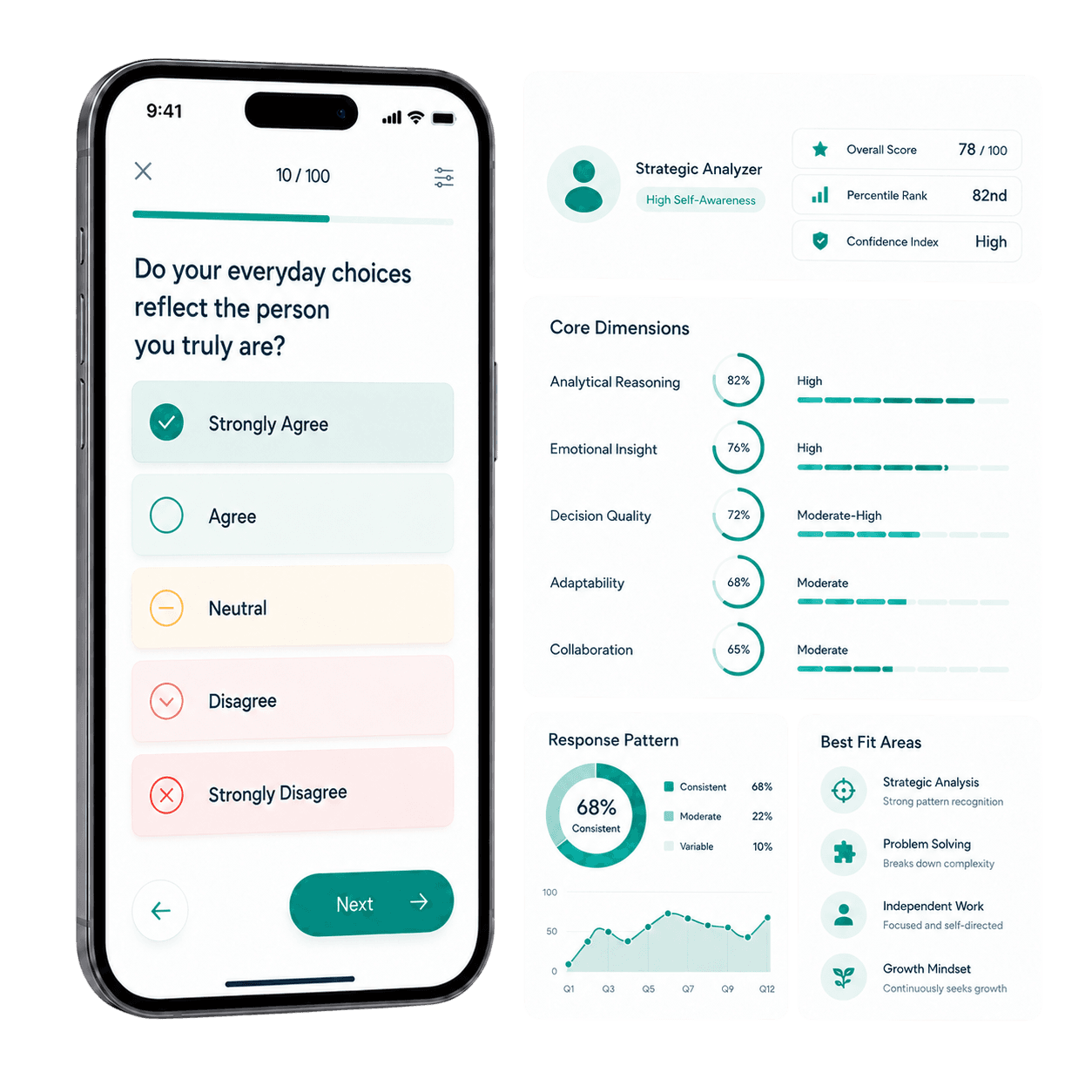
TestCore Relationship Attachment Test and personalised report preview

Separate the relationship facts from the attachment story you add to them

This test focuses on your own recurring expectations and responses around support, closeness, distance, trust, conflict and repair — without pretending they explain the other person.

Notice what you assume before you ask

Do you expect support to be available, fear that asking will make you too much, wait for proof that the other person cares or decide it is safer to need nothing? Those assumptions influence what you communicate.

  • Expectations about support
  • Fear around needs
  • What remains unspoken

Find the point where interpretation becomes reaction

A changed tone, cancelled plan or request for space is an event. The story you attach to it may be rejection, loss of control, danger, relief or nothing serious. That interpretation often drives the next move.

  • What happened
  • What you believed it meant
  • What you did next

Turn the result into a clearer request or boundary

The useful next move is not labelling yourself or the other person. It is recognising what you need enough to ask directly, tolerate an answer and respond with more choice than the automatic pattern gives you.

  • Name the need
  • Ask or set the boundary directly
  • Judge the response on its actual merits

How it works

1

Answer from relationships that mattered

Use bonds where trust, dependence, closeness, conflict and emotional availability had enough weight to reveal your usual response.

2

Get one leading attachment profile

TestCore compares your answers across five profiles. The result describes your reported pattern; it does not classify your partner or score the relationship itself.

3

Take the result back to the real dynamic

Use the report to separate your recurring expectation from the other person's actual behaviour and decide what needs clearer communication, firmer boundaries or more evidence.

Frequently asked questions

Q

Can this test tell me whether my relationship is healthy?

No. It describes your own attachment-related tendencies. Relationship health also depends on safety, respect, consistency, compatibility, communication and the other person's behaviour.

Q

Can it tell me my partner's attachment style?

No. The result is based on your self-report. It cannot reliably classify someone else from your interpretation of their actions.

Q

What if I feel very different in different relationships?

That difference matters. Trust, consistency, stress and relationship history can change how attachment concerns appear. Use the leading profile as a broad pattern while keeping important exceptions visible.

Q

Does the test decide whether I should stay or leave?

No. It is not a compatibility or relationship-decision tool. Use it to understand your own pattern, then evaluate the actual relationship on its behaviour and circumstances.

Q

Can relationship attachment patterns become more secure?

Yes. Safer and more consistent relationships, clearer communication, self-awareness and therapy can all support more secure ways of relating over time.

Q

Is this a diagnosis?

No. It is an educational self-report assessment, not a mental health diagnosis or clinical evaluation of you or another person.

Attachment insight is most useful when it increases responsibility without increasing self-blame

You can examine the expectations and protective habits you bring into a relationship without assuming every problem comes from you. The point is to separate what belongs to your pattern from what the other person's actual behaviour is showing you.

Distinguish the event from your first interpretation
Name the need before acting it out indirectly
Keep the other person's real behaviour in the evidence
Use attachment language to clarify your choices, not excuse poor treatment
Explore relationship attachment
Takes around 10 minutesPrivate and secure