
Testcore

Find the psychopathic traits that keep showing up when the context changes.

A recurring trait tells you more than one extreme moment. This assessment looks across emotional responsiveness, empathy and remorse, social influence, composure, risk, impulsivity and self-interest to see which broader tendencies persist across situations.

Fast results
Secure
Private
Trusted by thousands of curious users
Rated 4.8/5by our users
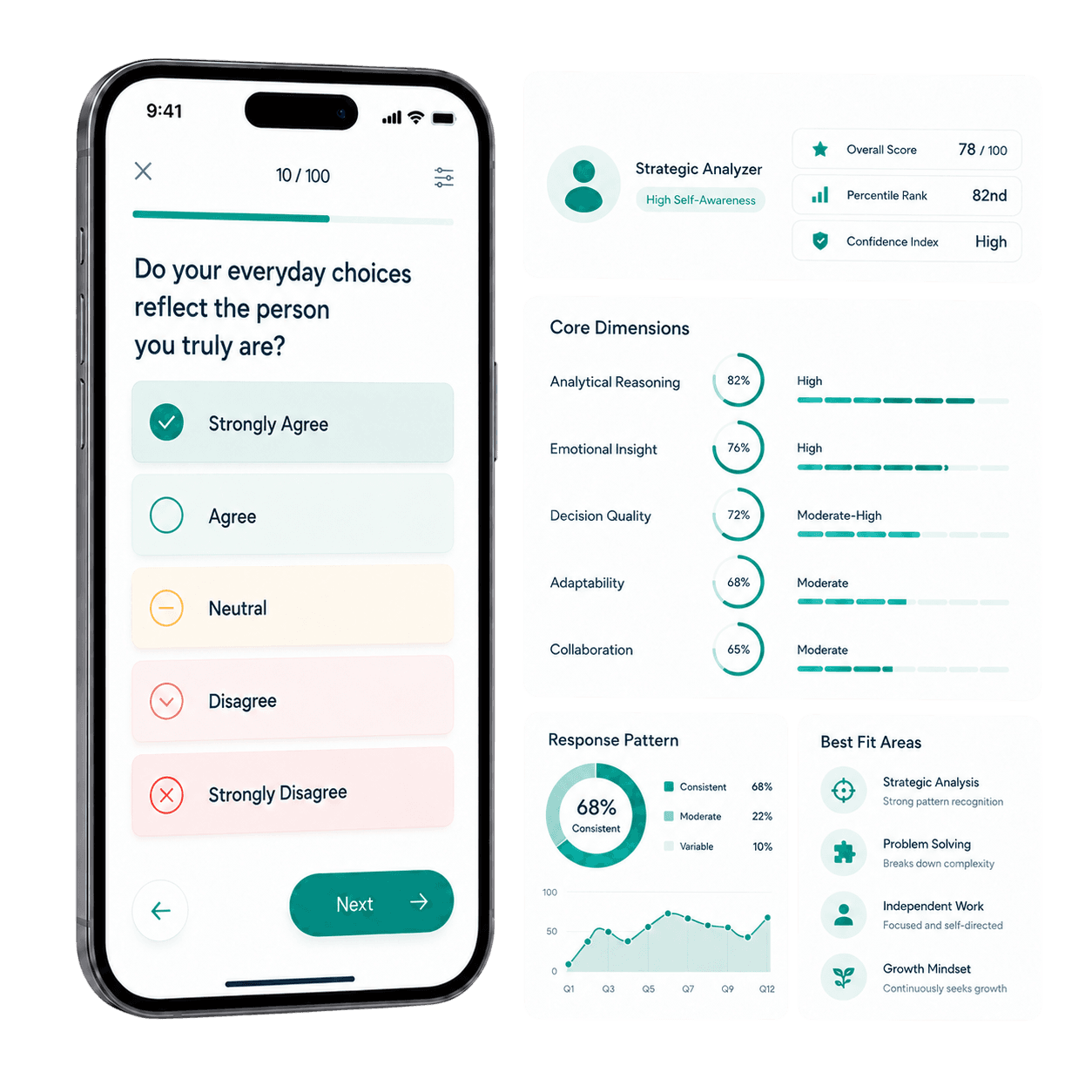
TestCore Psychopathic Traits Test and personalised report preview

A trait matters most when it survives a change of setting

Use repeated behaviour to separate a stable tendency from a one-off reaction. Then look at the practical trade-off: where the same quality helps you stay effective and where it begins to cost trust, reciprocity or consequence awareness.

Test emotional control against emotional responsibility

Composure can remain a strength until another person's distress repeatedly stops influencing the decision. Compare how calm you stay with how much empathy, concern and remorse still shape what you do.

  • Composure across pressure
  • Concern when someone else is affected
  • Whether remorse changes later behaviour

Test social strategy against reciprocity

Being adaptable and persuasive can be useful. Ask whether influence remains compatible with honesty and mutual benefit or whether other people increasingly become tools for reaching an outcome.

  • How deliberately you shape impressions
  • What happens when honesty has a cost
  • Whether the relationship stays reciprocal

Test risk tolerance against consequence awareness

Comfort with high stakes can support decisive action. The practical limit appears when speed, excitement or personal gain repeatedly outruns reflection about consequences for you or other people.

  • Attraction to high-stakes choices
  • Time spent considering consequences
  • What the outcome teaches you afterwards

How it works

1

Answer for behaviour that repeats

Think across different relationships and situations. A tendency that appears only during one crisis should not carry the same weight as something you recognise over time.

2

Read the result as one overall trait range

Your answers contribute to a single psychopathy-traits result. TestCore does not return separate clinical factors or numeric sub-scores for each tendency.

3

Locate the point where the trait becomes costly

Compare the report with trust, accountability, decision quality and consequences. That boundary is often more actionable than the trait name itself.

Frequently asked questions

Q

What are psychopathic traits?

Research models commonly include affective and interpersonal traits such as reduced empathy or remorse and manipulative social behaviour, alongside behavioural tendencies such as impulsivity, irresponsibility or risk-taking. Different instruments organise these traits differently.

Q

Are psychopathic traits all-or-nothing?

No. Traits can vary in degree and context. An online self-report result should not be treated as a simple psychopath versus non-psychopath category.

Q

Will I receive separate trait scores?

No. TestCore provides one overall psychopathy-traits range. The report discusses multiple themes but does not provide dedicated numeric sub-scores for empathy, manipulation, impulsivity or other traits.

Q

Is this a validated clinical psychopathy instrument?

No. It is not the PCL-R, LSRP, TriPM or another named psychopathy measure, and it should not be interpreted as equivalent to one.

Q

Can the same trait be useful in one setting and harmful in another?

Yes. Composure, independence, confidence and strategic thinking can be useful. Their impact changes when empathy, honesty, accountability or consequence awareness repeatedly drops out of the picture.

Q

Does this result predict dangerousness?

No. The assessment does not predict violence, criminal behaviour or dangerousness.

The useful boundary is where a tendency starts changing the outcome

Trait language is most practical when it helps you see a repeated trade-off: what the tendency gives you, what it costs, and whether the same consequence keeps returning.

One overall psychopathy-traits range
Context for emotional, interpersonal and risk-related tendencies
A way to separate repeated traits from one-off reactions
A clearer place to examine trust, accountability and consequences
Explore recurring trait patterns
Takes around 10 minutesPrivate and secure