
Testcore

Find the personality pattern that keeps showing up when the context changes.

This is TestCore's nine-type personality assessment. It identifies the strongest type pattern in your answers, then helps you examine how the same motives and strengths can look different in relationships, work and moments of pressure.

Fast results
Secure
Private
Trusted by thousands of curious users
Rated 4.8/5by our users
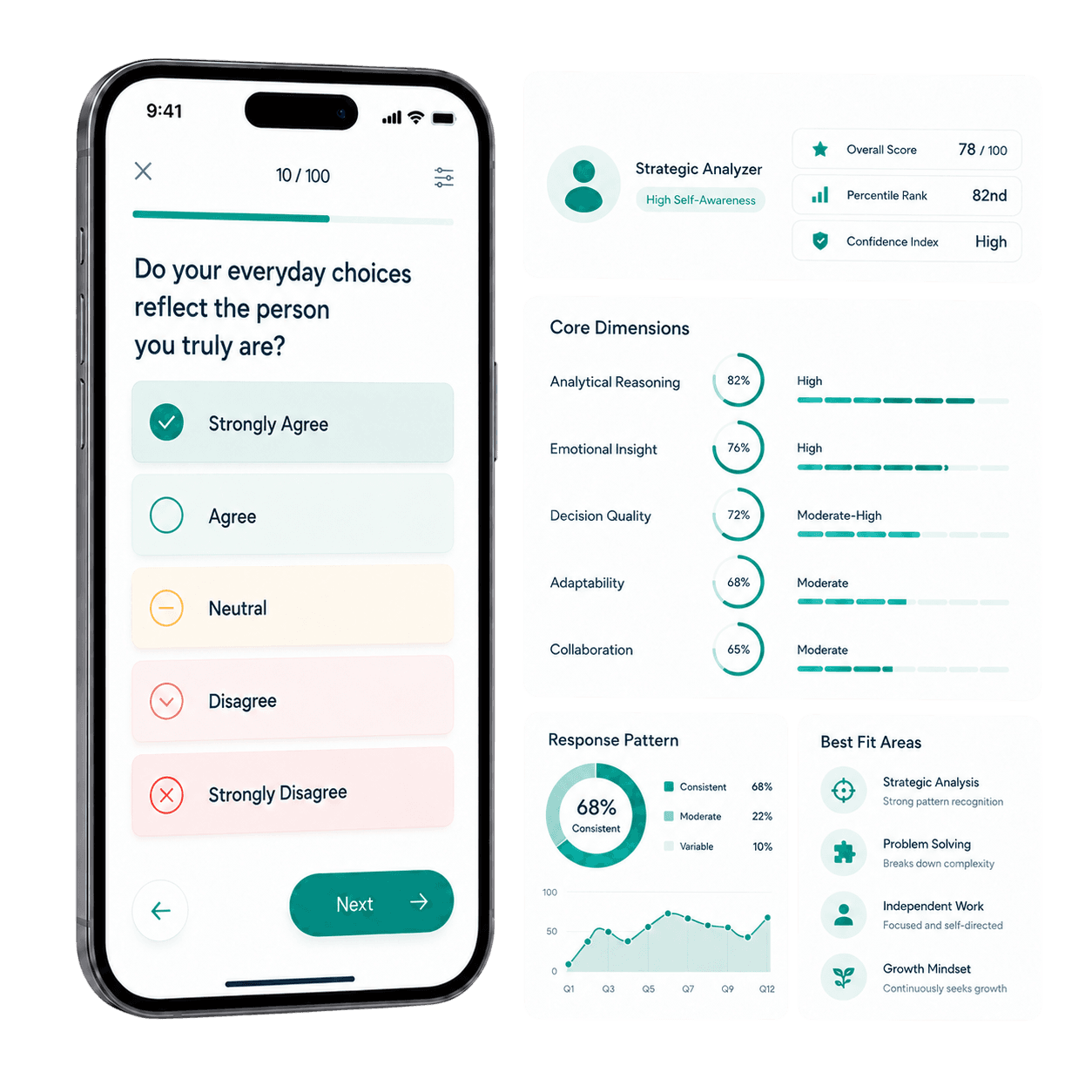
TestCore Personality Patterns Test and personalised report preview

A recurring personality pattern is bigger than one habit

The useful question is not whether you repeat one exact behaviour. It is whether the same motive or default approach keeps resurfacing in different situations — especially when the stakes rise.

Identify the strongest pattern across your answers

Your responses are compared across nine personality types. The strongest type gives you one organising pattern to examine instead of treating every reaction as a separate habit.

  • One dominant personality type
  • Characteristics associated with the pattern
  • Motivations and fears that may sit underneath it

See how the pattern changes with context

A drive for standards, security, recognition, connection, independence or harmony can produce different behaviour at home, at work and under stress. The report gives you several contexts to compare.

  • Relationship context
  • Career and work themes
  • Stress and balance observations

Catch the point where a strength becomes overused

The report connects type strengths with pressure and growth themes so you can look for the moment a useful default becomes rigid, draining or less effective — and choose a different response sooner.

  • Where the pattern can become costly
  • Growth themes associated with the type
  • One practical response to test next

How it works

1

Answer from repeated experience

Think across different situations rather than one recent incident. The goal is to capture the tendencies that feel familiar enough to show up again and again.

2

Find the dominant type pattern

Your answers contribute to nine personality-type scores. The strongest overall pattern becomes the type shown in your result.

3

Compare the pattern where it matters

Use the motivations, relationships, career, stress and growth sections to see which parts repeat across contexts and where a different response would be more useful.

Frequently asked questions

Q

What does the Personality Patterns Test actually measure?

It is TestCore's general nine-type personality assessment. Your answers are compared across nine personality types and the strongest pattern becomes your dominant type.

Q

Does it map a trigger, reaction and consequence for each habit?

No. The assessment does not produce a behavioural-loop or trigger-chain score. The report describes the broader characteristics, motivations, stress responses and life contexts associated with your dominant personality type.

Q

Why call a personality type a pattern?

A type groups recurring characteristics and motives that may show up differently across situations. Looking for the pattern can be useful when the surface behaviour changes but the same priority or fear keeps appearing underneath it.

Q

What parts of life does the report cover?

The report covers key characteristics, motivations and fears, relationships, career and work, stress and balance, personal growth and interactions with other types.

Q

Can the result tell me how I will behave next time?

No. A personality pattern can give you context for recurring tendencies, but it does not predict a specific future action. Situation, experience and deliberate choices still matter.

Q

Is this a clinical personality-pattern assessment?

No. TestCore provides an educational self-reflection assessment. It does not diagnose personality disorders, emotional-defence patterns or any other medical or psychological condition.

The pattern is often in the reason, not the exact behaviour

You may take charge in one situation and stay quiet in another while still protecting the same underlying priority. Look for what stays consistent when the surface response changes.

Compare the motive beneath different-looking reactions
Notice which strengths repeat across work and relationships
Watch what becomes exaggerated when pressure rises
Use the pattern to create an earlier choice point, not an excuse
Find your personality pattern
Takes around 10 minutesPrivate and secure