Testcore

See what your personality type brings into relationships before the same friction repeats.

This is TestCore's general personality assessment, not a couple compatibility test. Your type report includes relationship themes and type-to-type context so you can examine how your usual motives, expectations and pressure responses may affect the way you connect with other people.

Fast results
Secure
Private
Trusted by thousands of curious users
Rated 4.8/5by our users
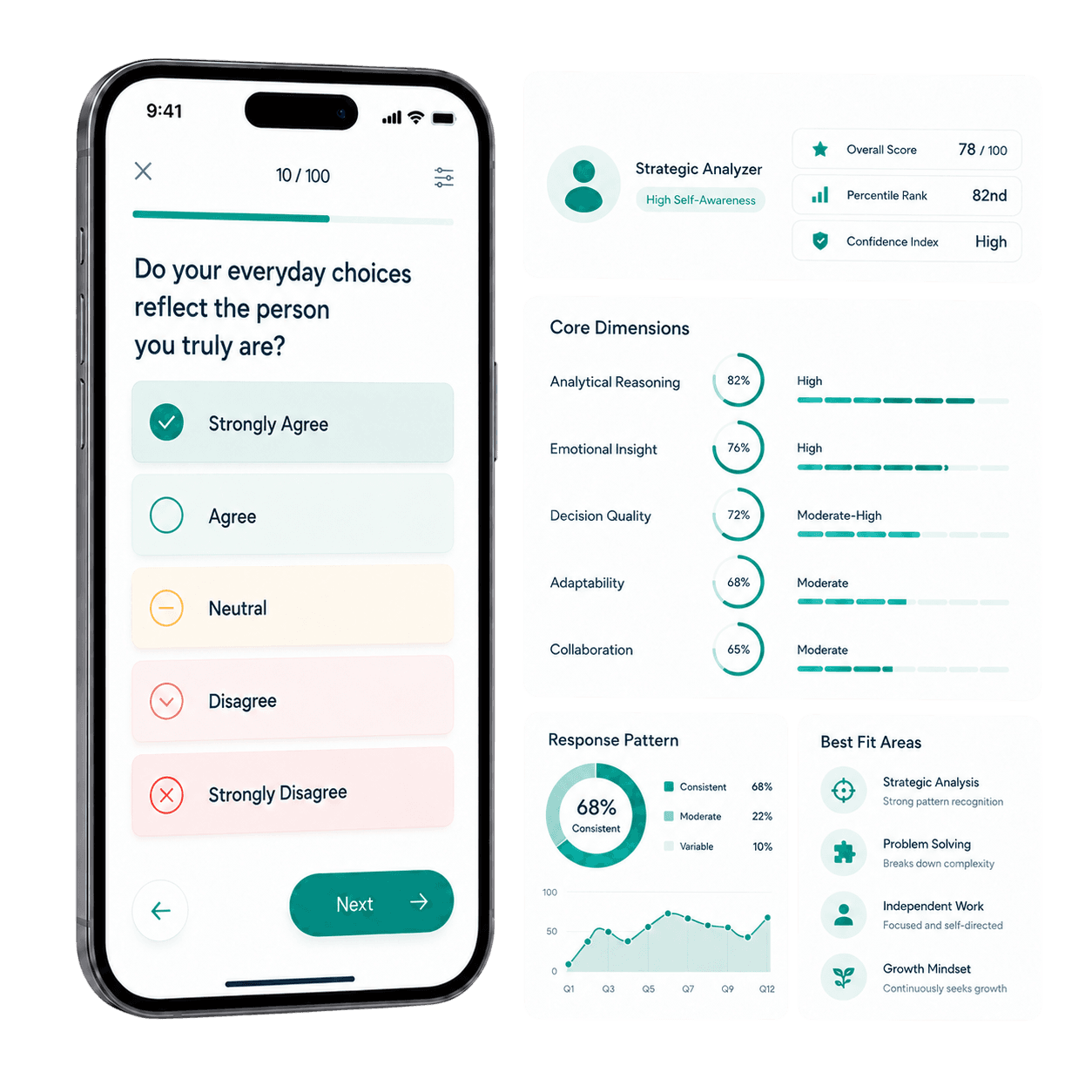
TestCore personality in relationships report preview

Relationship patterns make more sense when you can see what each reaction is protecting

The same argument can look like a communication problem on the surface while different motives sit underneath it. Your personality type gives you one way to examine those motives without turning the relationship into a compatibility score.

Understand what your type tends to need from connection

The relationship section describes characteristic strengths and challenges associated with your type, helping you compare the report with how you handle expectations, responsibility, closeness and disagreement.

  • Relationship strengths associated with the type
  • Needs and expectations worth making explicit
  • Challenges that may recur when the pattern is overused

See why pressure changes the conversation

A familiar type pattern can become more rigid when you feel criticised, overlooked, controlled, uncertain or responsible for keeping things together. Stress context helps you notice that shift before it becomes the whole interaction.

  • What may become louder under stress
  • Where good intentions can create friction
  • A clearer point to pause or communicate differently

Use compatibility notes as context, not a verdict

The report includes observations about how your type may interact with other types. Those notes can help explain differences in style; they cannot decide whether a relationship is healthy, compatible or worth continuing.

  • Type-to-type differences to discuss
  • No compatibility percentage or pass/fail result
  • One relationship pattern to examine more deliberately

How it works

1

Find your overall personality type

Answer the general personality assessment according to what is usually true for you. The questions are not a relationship checkup and do not score the quality of a specific partnership.

2

Read the relationship section against real examples

Compare the type description with moments of closeness, disagreement, expectations, support and responsibility that you recognise from your own relationships.

3

Take one pattern into the next conversation

Use the result to name a need more clearly, notice an automatic reaction earlier or ask whether the other person's style is different rather than simply wrong.

Frequently asked questions

Q

Is this a relationship personality test or a couple compatibility test?

You take TestCore's general nine-type personality assessment. The report includes relationship themes and type-to-type context, but it does not assess a specific couple or produce a compatibility percentage.

Q

What can my personality type tell me about relationships?

It can give you a structured way to examine characteristic strengths, challenges, motivations, fears and stress responses that may affect how you communicate and relate to other people.

Q

Will the report tell me whether my partner and I are compatible?

No. The type-compatibility section describes possible areas of ease and friction between personality types. It is context for reflection, not a verdict about a relationship.

Q

Do both people need to take the test?

No. This route begins with your own personality result. If another person knows their type, you may find the type-to-type notes useful for comparison, but the assessment does not create a joint couple score.

Q

Can personality explain every relationship problem?

No. Relationship dynamics also depend on communication, history, values, circumstances, boundaries, trust and many other factors. Personality is one lens, not a complete explanation.

Q

Is this a clinical or diagnostic relationship assessment?

No. It is an educational self-reflection tool and does not diagnose a person, assess relationship safety or replace professional relationship or mental-health support.

A type can explain a recurring reaction without excusing it

Understanding why you become more critical, distant, accommodating, controlling, anxious or conflict-avoidant under pressure can make a relationship pattern easier to interrupt. The explanation is useful when it creates more choice, not when it becomes a reason the pattern has to continue.

Name the motive or fear underneath a familiar reaction
Separate your intention from the effect the behaviour has on someone else
Use type differences to ask better questions instead of assigning blame
Treat compatibility notes as conversation context, never a relationship verdict
See your relationship pattern
Takes around 10 minutesPrivate and secure