Identify what keeps recurring
Notice whether praise, status, entitlement, comparison or criticism reliably changes the way you see yourself or respond to other people.
- Recognition
- Comparison
- Criticism sensitivity
A trait matters because it repeats. Look at whether recognition, entitlement, comparison, criticism, self-focus and empathy show a consistent pattern across work, relationships, competition and everyday decisions.
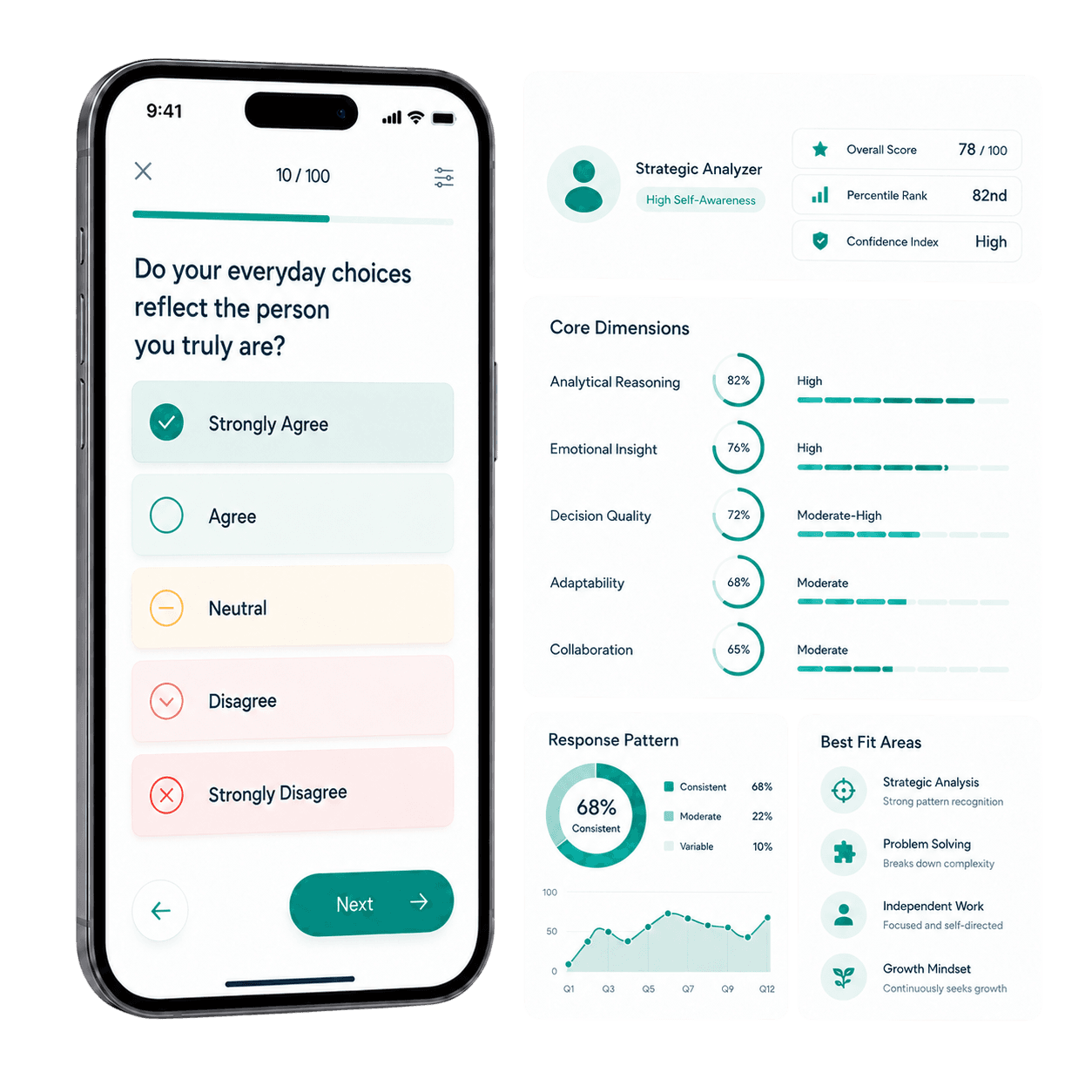
The assessment looks across repeated self-reported tendencies so you can separate a one-off defensive or self-focused moment from a pattern that follows you into several parts of life.
Notice whether praise, status, entitlement, comparison or criticism reliably changes the way you see yourself or respond to other people.
Ask whether the recurring tendency makes listening, sharing credit, accepting limits, admitting mistakes or staying open to feedback harder.
Use the report to turn a general description into one observable response you can catch earlier under pressure.
Think about work, close relationships, friendships, competition, mistakes and moments when recognition or status feels especially important.
Your responses are combined into one broad result. The product does not return separate numeric scores for entitlement, admiration, empathy or other individual traits.
Choose the tendency with the clearest real-life cost and decide what you want to notice, pause or do differently the next time the same pressure appears.
They are recurring tendencies often discussed around grandiosity, admiration, entitlement, superiority, comparison, criticism sensitivity, self-focus and reduced attention to other people's perspectives. Different traits can appear at different strengths.
No. Trait-level tendencies and a clinical personality-disorder diagnosis are not the same thing. This assessment cannot diagnose NPD.
No. The result is an overall range based on many answers. Use the report to identify which themes actually match repeated behaviour in your own life rather than assuming every characteristic fits equally.
No. TestCore is an educational self-reflection assessment and is not presented as the NPI, PNI or another validated external narcissism instrument.
No. The final result is one overall narcissistic-traits range. Those themes are represented in the questions and report context but are not delivered as separate numeric sub-scores.
Pick one recurring tendency with a clear impact — such as praise dependence, defensiveness, comparison or difficulty sharing attention — and watch it across several real situations before deciding what to change.
The practical value is not the label itself. It is recognising where a recurring tendency affects feedback, decisions, reciprocity or relationships strongly enough to deserve a different response.