Find what changes together
Compare mood with sleep, energy, activity, confidence, motivation, decisions, social behaviour and the ability to keep routines steady.
- What shifts first
- Which changes cluster together
- What returns to baseline later
A pattern has a sequence: what changes first, what changes with it, how long the period seems to persist, what it disrupts and what happens as your usual rhythm returns.
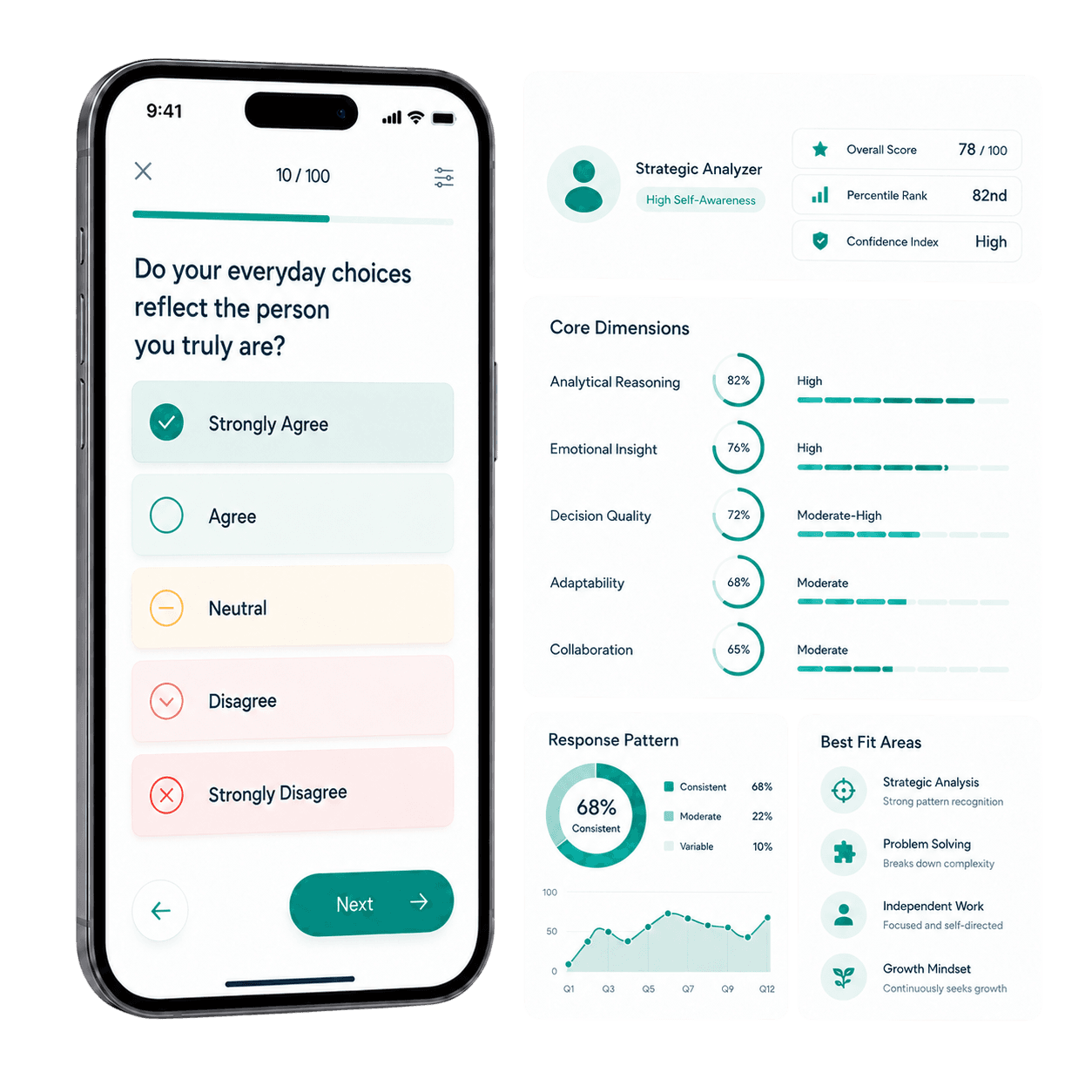
This route is about sequence and co-occurrence. Instead of collecting isolated highs or lows, it asks whether several changes tend to travel together across a recognisable period.
Compare mood with sleep, energy, activity, confidence, motivation, decisions, social behaviour and the ability to keep routines steady.
A useful pattern includes more than intensity. Look at whether a period is brief or sustained and what it changes in work, relationships, spending, responsibilities or recovery.
The result cannot diagnose an episode. It can help you reconstruct recurring sequences clearly enough to monitor them or discuss them with a qualified professional.
Bring to mind periods when several parts of your usual rhythm felt different and compare what happened before, during and after them.
All answers contribute to one Minimal-to-Strong Traits result. TestCore does not calculate cycle length or diagnose mania, hypomania, depression or mixed features.
Review which changes repeat, which appear together, which create the clearest consequences and what tends to happen as you return to baseline.
The main route is broad. This page focuses on sequence and timing: what changes together, how the pattern unfolds across a period and what happens before or after the shift.
No. The questionnaire asks about recurring experiences but does not calculate clinical episode duration. Duration remains part of the wider context a clinician would assess.
A single change such as low mood, high energy, irritability or poor sleep can have many explanations. A broader cluster occurring in the same period gives more context, although it still cannot establish a diagnosis.
You receive one overall bipolar-traits level from Minimal to Strong Traits plus a narrative report. There is no separate cycle, duration, mania, depression or recovery score.
Yes. If the pattern concerns you, recording dates, sleep, energy, behaviour, major events and daily impact can provide useful context beyond a one-time self-report.
Seek qualified support if changes are severe, recurrent, escalating, disrupting daily functioning, involve risky behaviour or affect your safety. An online result is not a replacement for care.
Memory tends to keep the dramatic moment and lose the surrounding details. Reconstructing the order of sleep, energy, activity, decisions and recovery can make the pattern much easier to evaluate.