Notice what you pick up
Look at emotional cues, mood changes, social tension and how readily you try to understand another person's point of view.
- Emotional awareness
- Social reading
- Perspective-taking

Trait empathy is about what tends to recur: noticing emotion, understanding another viewpoint, feeling concern, stepping in to help, absorbing the atmosphere or protecting your own emotional space.
Instead of asking only whether you are empathetic, look at the tendencies that repeat often enough to shape relationships, choices and emotional energy.
Look at emotional cues, mood changes, social tension and how readily you try to understand another person's point of view.
See how compassion and helping tendencies influence the amount of time, energy and responsibility you take on when someone is struggling.
Emotional sensitivity can strengthen connection and also increase fatigue. Boundaries help show whether empathy is sustainable in practice.
Think across time and different relationships instead of using one unusually caring or difficult moment as the whole picture.
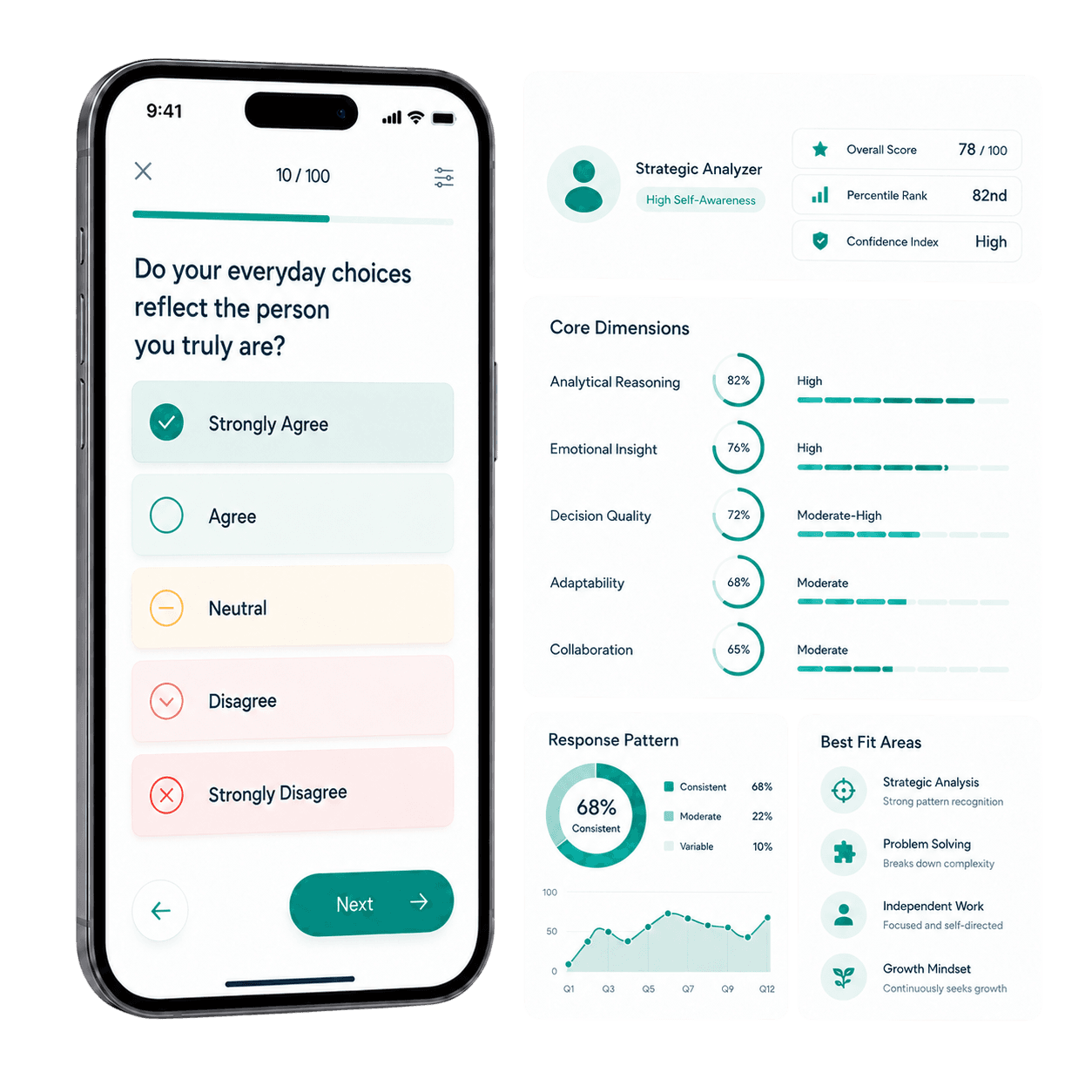
The assessment combines recurring empathy-related responses into one broad result, then the report adds context around how those tendencies may show up.
Use the report to identify one recurring tendency you can actually watch: assumption-making, emotional absorption, helping too quickly or failing to state a boundary.
Trait empathy describes relatively recurring tendencies to understand, feel with or respond to other people's experiences. It is about what is often true, not what happens in every single interaction.
No. Context, stress, trust, role, experience and practice can all change how empathy-related tendencies appear in a particular situation.
No. Emotional sensitivity and compassion do not guarantee accurate interpretation. Perspective-taking still works best when you check assumptions against what the other person actually says or does.
Because strong emotional absorption can become tiring. Being able to care without taking ownership of another person's emotional state helps empathy remain sustainable.
No. TestCore is an educational self-reflection assessment and is not presented as the IRI, Toronto Empathy Questionnaire, Empathy Quotient or another validated external instrument.
Pick one recurring trait that appears across several settings and watch how it affects your next few interactions. That is more useful than treating the result as a permanent identity label.
Move from “I am empathetic” to a more useful description of what you notice, feel, do and carry.