Listen before filling in the motive
Notice whether you stay curious about what the other person means or move quickly from a cue to a confident story about why they acted that way.
- Active listening
- Assumption checking
- Perspective-taking
Close relationships test empathy under pressure: listening when you feel misunderstood, offering support without taking over, seeing another viewpoint during conflict and holding a boundary without shutting down.
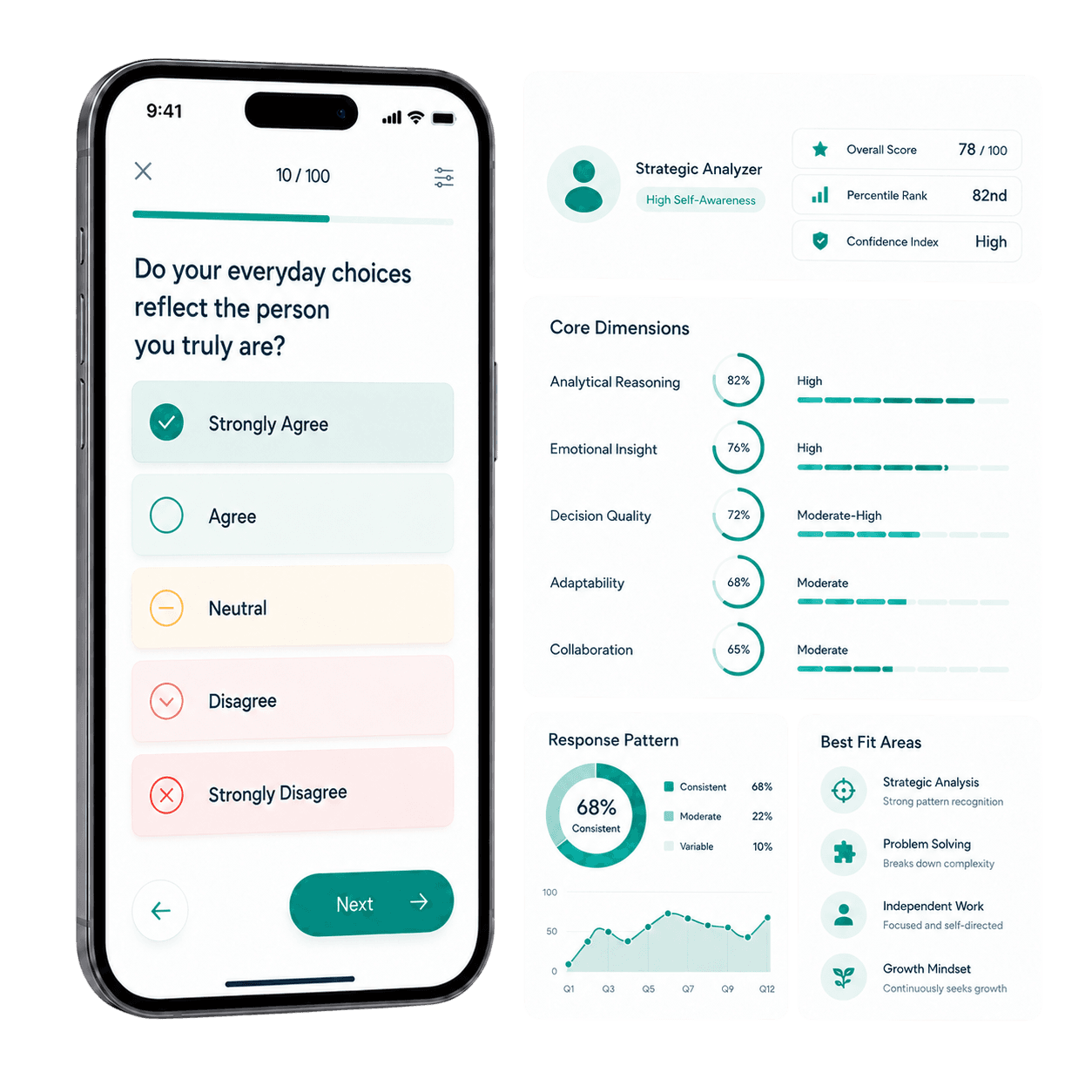
The broader empathy assessment can help you reflect on your own side of listening, support, conflict and emotional boundaries without pretending to score relationship quality or compatibility.
Notice whether you stay curious about what the other person means or move quickly from a cue to a confident story about why they acted that way.
See whether care turns into fixing, rescuing or carrying emotional responsibility that belongs partly or entirely to the other person.
Look at what happens when your own hurt, anger or defensiveness competes with the ability to understand the other person's experience.
Think about partners, family and close friends — especially moments involving disagreement, reassurance, disappointment, emotional distance or support.
The test returns a broader empathy range, then the report gives context you can apply to listening, emotional sensitivity, perspective-taking, helping and boundaries.
Use the report to catch an assumption, a rescuing reflex, emotional overload or avoidant response before it decides the next conversation for you.
No. It reflects your own empathy-related tendencies. It does not assess compatibility, relationship health, abuse, safety or the other person's behavior.
No. You can understand why someone feels a certain way and still disagree with their conclusion, reject harmful behavior or keep a firm boundary.
Support responds to another person's need while leaving them ownership of their feelings and choices. Over-responsibility starts when you feel required to fix, prevent or carry emotional outcomes that are not fully yours.
When you feel threatened, hurt or blamed, your own interpretation becomes more urgent. That can make another viewpoint harder to consider even if you are normally empathetic.
No. It is an educational self-reflection assessment and does not replace couples counselling, therapy or other professional support.
Choose one concrete behavior to watch in your next important conversation: interrupting, assuming, fixing too quickly, withdrawing, absorbing the other person's mood or failing to state a boundary.
The practical target is understanding with enough boundary to stay honest, useful and present.