Notice the signal
Pay attention to tone, silence, mood changes, body language, context and the difference between what is said and what seems to be happening emotionally.
- Tone and mood shifts
- Subtle social cues
- Context around the interaction
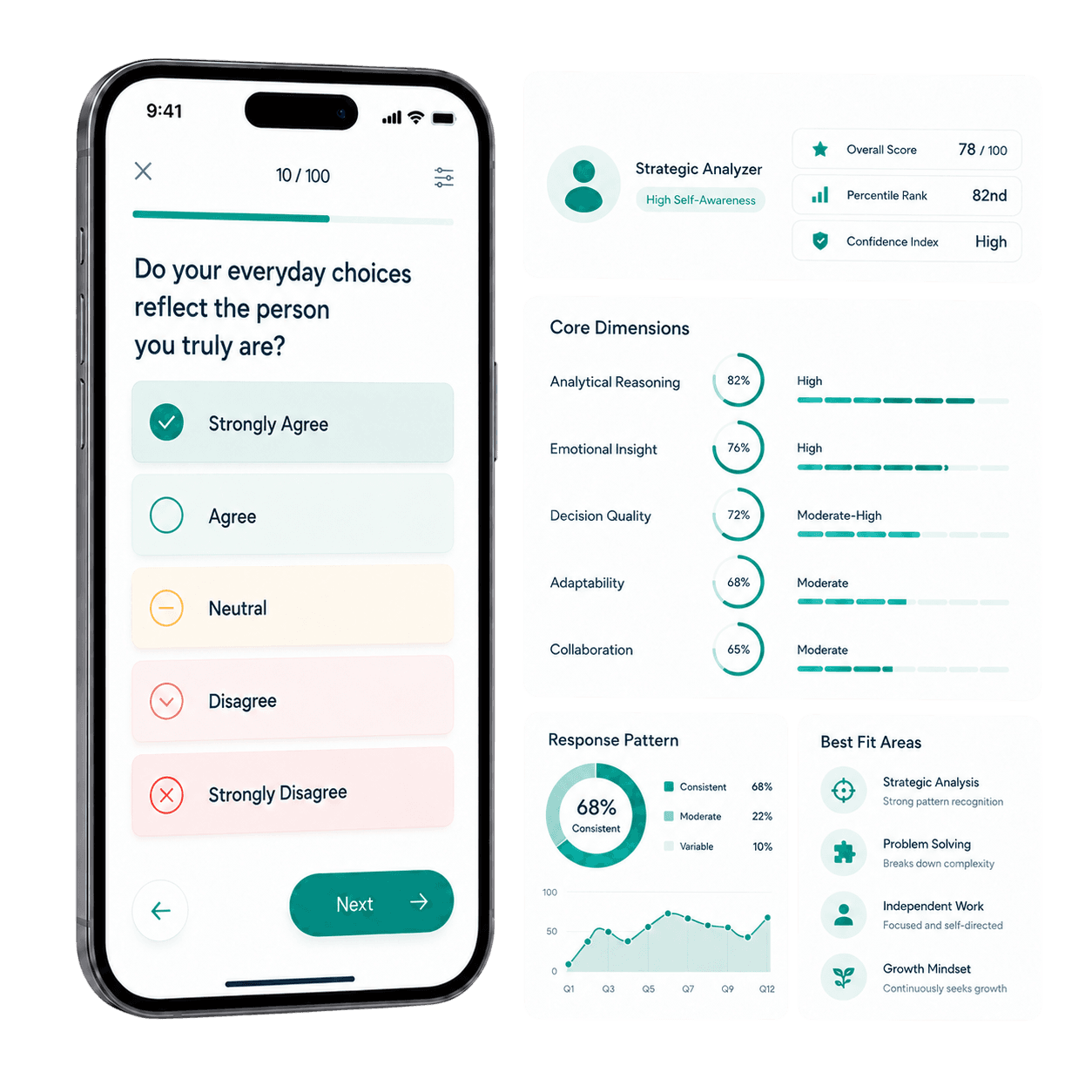
Emotional understanding is one part of empathy. This assessment looks at how you notice cues, interpret another person's feelings and perspective, and respond when the emotional message is incomplete or ambiguous.
The goal is not perfect certainty about what someone feels. It is noticing more evidence, making fewer automatic assumptions and knowing when to ask instead of guess.
Pay attention to tone, silence, mood changes, body language, context and the difference between what is said and what seems to be happening emotionally.
Separate what you observed from the story you built around it, then consider whether another explanation could fit the same evidence.
Use emotional understanding to ask a clearer question, adjust your communication or avoid reacting to a motive the other person never actually had.
Think about conversations where someone seemed distant, defensive, disappointed, tense or difficult to read.
The assessment also includes perspective-taking, emotional sensitivity, compassion, helping and boundaries, so the result is broader than a dedicated emotion-recognition score.
Apply the report to the conversations where a checked assumption or one extra question could change the outcome.
It is the ability to notice and make sense of emotional information — including cues, context and another person's perspective — without assuming your first interpretation is automatically correct.
It is one part of empathy. Empathy can also include emotional resonance, compassion, helping behavior and the way you manage emotional boundaries.
No. It is a self-report empathy assessment, not a performance task where you identify facial expressions or receive a dedicated emotion-recognition accuracy score.
Yes. Understanding another perspective does not require agreement, approval or surrendering your own boundary.
No. It is an educational self-reflection tool and does not diagnose a social, emotional or psychological condition.
Use it to identify the conversations where you tend to infer too quickly, miss subtle cues or need more information before deciding what another person means.
The practical skill is not knowing exactly what someone feels. It is knowing when your explanation is evidence and when it is still a guess.