Testcore

See what emotional intensity changes once it becomes the loudest thing in the room.

Feeling deeply is not the problem by itself. The useful question is what happens when intensity changes your interpretation, your behavior, your self-image, or the way you relate to someone important.

Fast results
Secure
Private
Trusted by thousands of curious users
Rated 4.8/5by our users
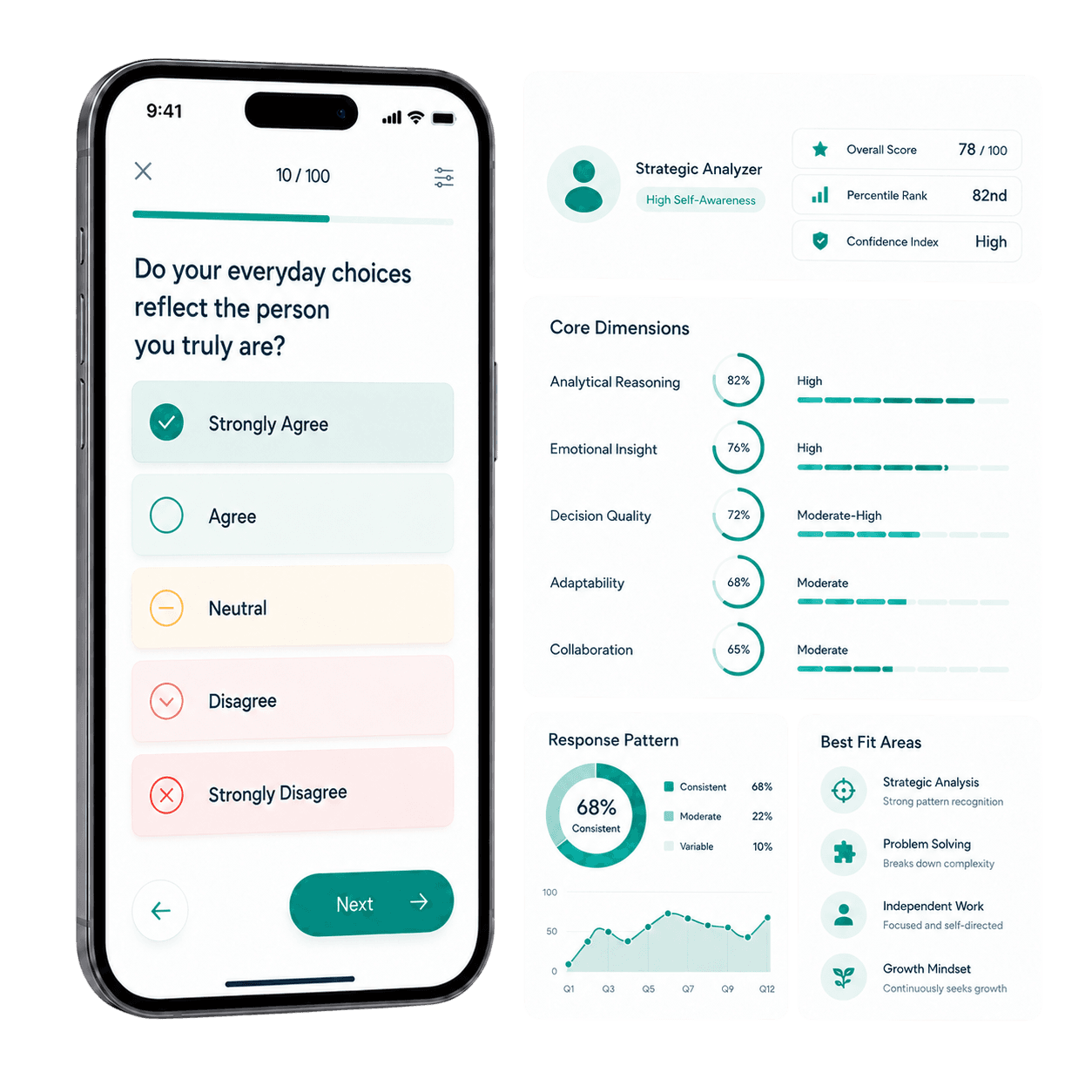
TestCore Emotional Intensity Test and personalised report preview

Intensity matters most when you understand its context and aftermath

This page focuses on the strength, speed, duration, and consequences of emotional reactions inside the wider BPD-traits assessment.

Separate strong feeling from strong impact

An emotion can be intense without disrupting your life. Pay attention to when intensity changes communication, choices, concentration, self-worth, or the ability to recover.

  • How strong it feels
  • How long it lasts
  • What it changes

Notice which situations repeatedly amplify emotion

Perceived rejection, criticism, conflict, uncertainty, loneliness, or closeness may have different effects. Comparing those situations can reveal the pressure points that matter most.

  • Repeated triggers
  • Escalation speed
  • Recovery time

Keep intensity in the wider BPD context

The full assessment also covers relationships, identity, impulsive behavior, anger, emptiness, and stress-related experiences so one intense feeling does not become the whole explanation.

  • A broader pattern
  • Fewer simplistic conclusions
  • Clearer next steps

How it works

1

Answer from several emotional situations

Think across conflict, rejection, closeness, criticism, loneliness, and other moments that reliably bring strong feelings forward.

2

Receive one overall traits level

Your responses produce a single BPD-traits result from Minimal Traits to Strong Traits. Emotional intensity is not scored as a separate clinical dimension.

3

Compare intensity with consequences

Use the report to examine how strong emotion interacts with relationships, identity, behavior, communication, and daily functioning.

Frequently asked questions

Q

What does the Emotional Intensity Test explore?

It explores how strongly and quickly emotions can arise, what tends to trigger them, how long they remain active, and how they may affect behavior, relationships, and self-perception.

Q

Does feeling emotions intensely mean I have BPD?

No. Emotional intensity can occur for many reasons. BPD diagnosis involves a broader persistent pattern across emotions, relationships, self-image, behavior, and functioning.

Q

Will I get an emotional-intensity score?

No. TestCore reports one overall BPD-traits level and discusses emotional intensity narratively in the report.

Q

Why does the test ask about relationships?

Strong emotions often become most meaningful in context. Perceived rejection, closeness, conflict, and uncertainty can change both the intensity and the consequences of a reaction.

Q

Is this a clinical assessment?

No. It is a self-report reflection tool and cannot confirm or rule out borderline personality disorder.

A strong feeling is real without being a diagnosis.

The useful distinction is whether emotional intensity is occasional or part of a recurring pattern that changes relationships, decisions, self-image, or daily functioning.

Context for strength, speed, and duration
One overall BPD-traits result
A wider view that includes relationships and behavior
A private narrative report based on your answers
Understand emotional intensity
Takes around 10 minutesPrivate and secure