
Testcore

Find what happens between the trigger and the reaction

Emotion regulation is not about never feeling strongly. It is about what happens once the feeling is active: whether you can slow down, keep perspective, and choose a response you can still stand behind later.

Fast results
Secure
Private
Trusted by thousands of curious users
Rated 4.8/5by our users
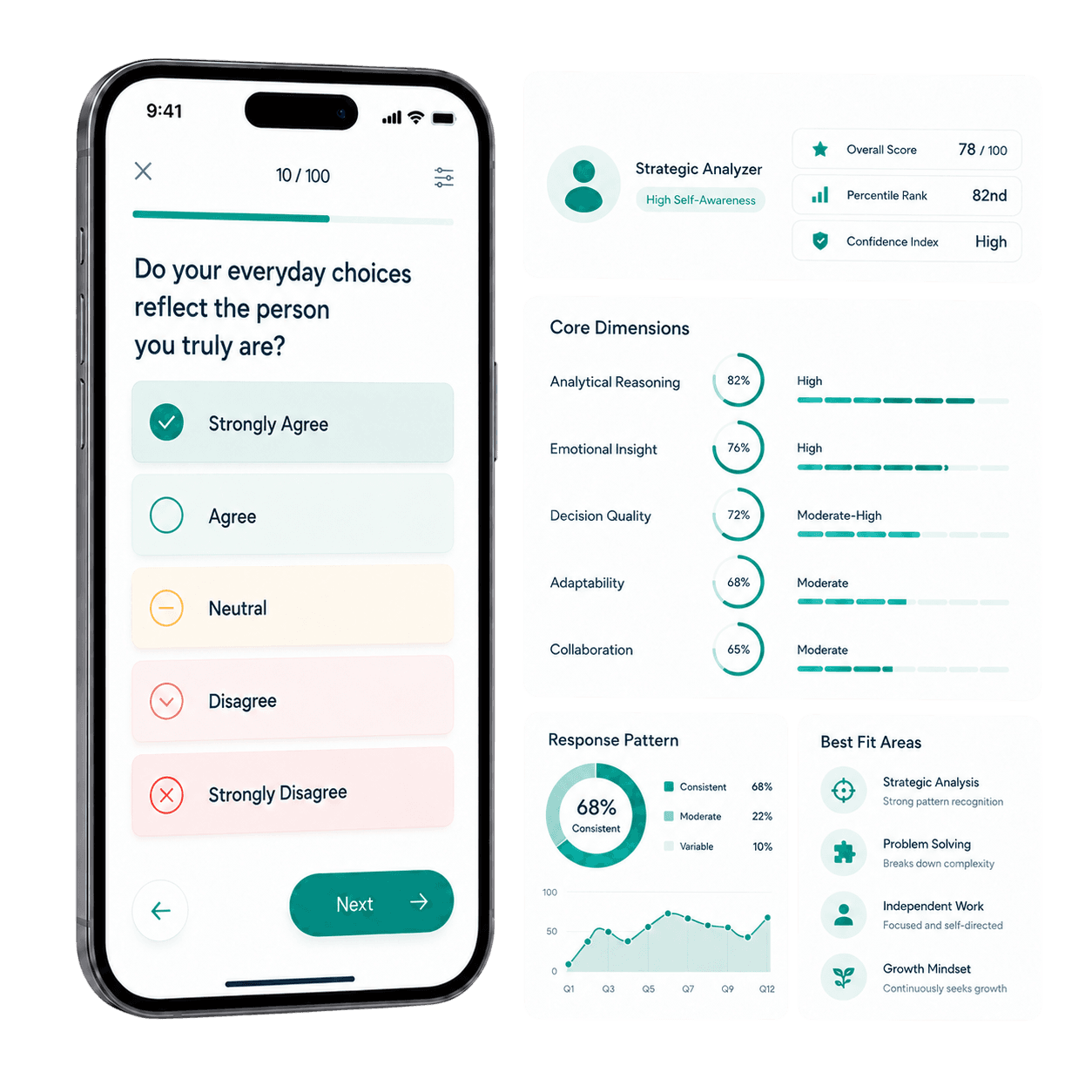
TestCore Emotion Regulation Test and personalised report preview

Regulation becomes clearer when you look at the full arc

This page focuses on escalation, behavioral control, recovery, and the situations that repeatedly make those skills harder to access.

Notice the first sign of escalation

Look for the moment when criticism, rejection, conflict, uncertainty, anger, or another stressor starts changing your body, attention, or interpretation of what is happening.

  • Early warning signs
  • Common triggers
  • Changes in perspective

See what happens when the pause disappears

The wider assessment includes impulsive action, anger, relationship reactions, identity shifts, and stress-related disconnection. Those details help show what regulation difficulty looks like in real life.

  • What becomes urgent
  • What behavior follows
  • What the aftermath costs

Use the pattern to find a better intervention point

The most useful insight is often not the final reaction but the earlier point where support, a skill, distance, or a different response could change the sequence.

  • A clearer pause point
  • More deliberate responses
  • A practical next conversation

How it works

1

Answer from repeated emotional situations

Think across different conflicts, relationships, and stressors rather than one unusually intense event.

2

Receive one overall BPD-traits level

Your answers are combined into a single level from Minimal Traits to Strong Traits. TestCore does not report a separate emotion-regulation score.

3

Use the report to compare escalation and recovery

Review emotional regulation alongside identity, relationships, behavior, communication, and daily functioning to see where the pattern is most disruptive.

Frequently asked questions

Q

What does the Emotion Regulation Test explore?

It looks at experiences related to emotional escalation, behavioral control, anger, impulsive reactions, recovery, and the broader BPD-related pattern covered by the assessment.

Q

Will I receive an emotion-regulation score?

No. The scoring produces one overall BPD-traits level. Emotion regulation is discussed in the narrative report rather than scored separately.

Q

Does difficulty regulating emotions mean I have BPD?

No. Emotional dysregulation can occur in many contexts and conditions. BPD diagnosis requires a broader professional assessment.

Q

Why does the test include relationships and identity?

Emotional regulation often interacts with perceived rejection, closeness, self-image, and behavior. Looking at those areas together gives more context than focusing on intensity alone.

Q

When should I seek additional support?

Consider qualified support if emotional reactions are persistent, highly distressing, unsafe, or disrupting relationships and daily functioning. Use urgent local crisis or emergency help if immediate safety is at risk.

The best intervention point is often earlier than the reaction you regret.

A self-test cannot diagnose BPD, but it can help you identify where emotional escalation begins and what repeatedly makes it harder to slow down.

Context for triggers and escalation
One overall traits result rather than a regulation subscore
Language for recovery, behavior, and relationship impact
A private report based on your responses
Explore emotion regulation
Takes around 10 minutesPrivate and secure