Notice what happens when praise is absent
Ask whether a good result still feels satisfying when nobody notices it, or whether recognition becomes part of what makes the achievement feel real.
- Praise dependence
- Recognition need
- Private achievement
Confidence can survive an ordinary mistake, a quiet achievement or someone else's success. Validation dependence becomes easier to see when praise disappears, criticism changes your mood or recognition starts to feel necessary rather than welcome.
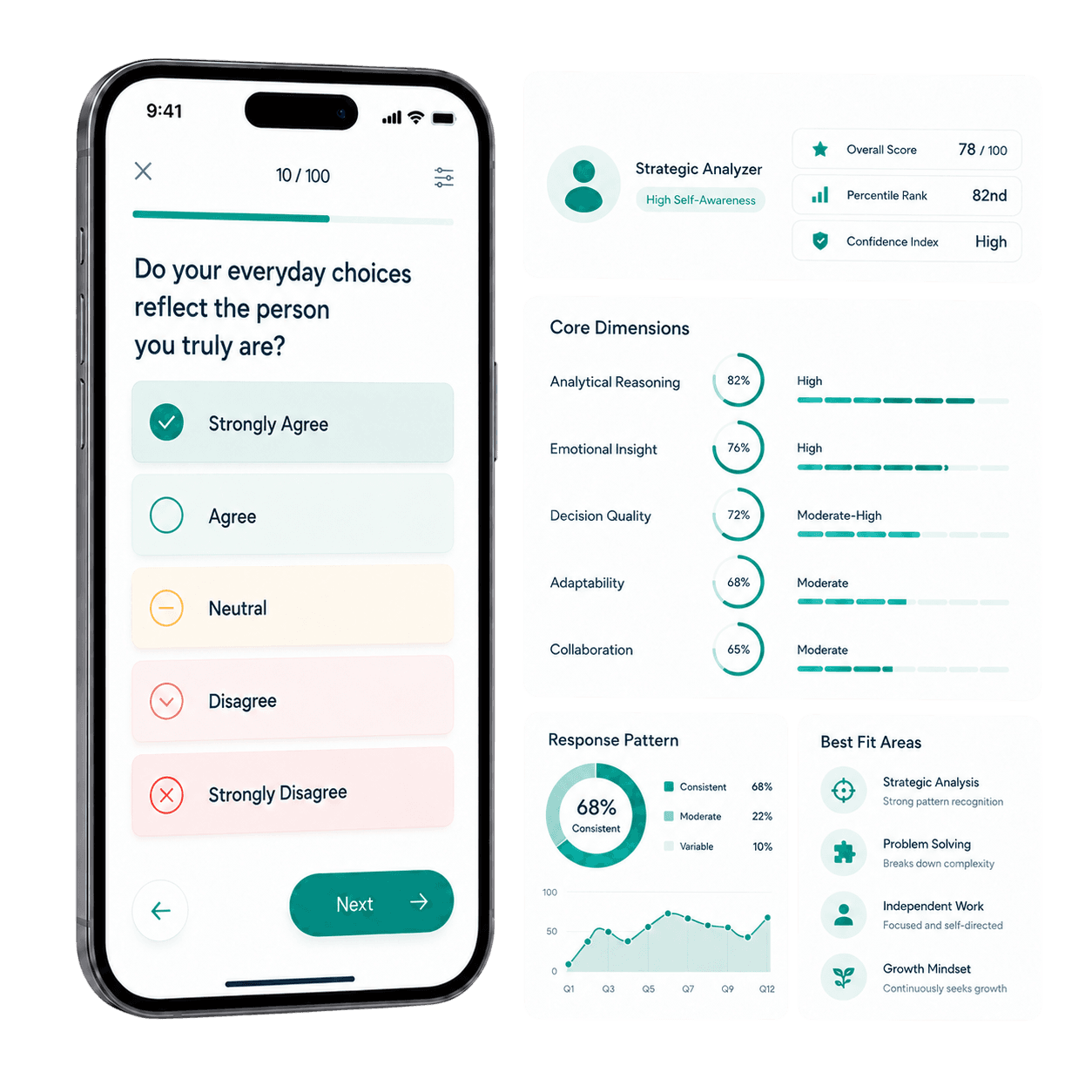
The broader narcissistic-traits assessment includes several questions about praise, recognition, criticism, comparison and intrinsic standards — useful clues for understanding confidence that depends on other people's response.
Ask whether a good result still feels satisfying when nobody notices it, or whether recognition becomes part of what makes the achievement feel real.
See whether feedback stays specific, or quickly changes your confidence, creates defensiveness or makes another person's success feel threatening.
Use the result to compare external approval with intrinsic standards such as doing good work, admitting mistakes and evaluating progress without constant applause.
Think about praise, being overlooked, public success, private success, criticism and situations where someone else's achievement changed how you felt about your own.
The final result is an overall narcissistic-traits range, not a separate validation score, but the questionnaire directly includes recognition, praise and criticism-related tendencies.
Use the report to identify where approval has too much influence and practice evaluating one decision, achievement or mistake by a standard you can apply without an audience.
This page focuses on how praise, recognition, criticism, comparison and external approval may influence confidence. It uses the broader narcissistic-traits assessment rather than a dedicated self-esteem instrument.
Not automatically. Most people value appreciation. It becomes more useful to examine when confidence repeatedly collapses without praise, criticism feels intolerable or recognition begins to control choices and relationships.
No. The assessment returns one overall narcissistic-traits range. Validation, recognition and criticism are important questionnaire themes, but they are not reported as a standalone numeric sub-score.
Internal confidence can still be affected by feedback, but it is less dependent on constant approval. External validation becomes more dominant when other people's praise, status signals or recognition determine whether you feel worthwhile or successful.
No. It is an educational self-reflection result and does not diagnose a mental-health or personality disorder.
Choose one situation where you usually look outward for proof — feedback, social recognition, status or comparison — and test what changes when you use a clearer internal standard first.
The goal is not to stop caring what other people think. It is to see whether recognition informs your self-view or controls it.