
Testcore

Know the contribution you should stop underselling and the situations where it works best.

A strength is more than something you can do. It is the kind of work you repeatedly make easier, clearer, faster, more useful, more original, or better directed. This test identifies the career pattern behind that contribution.

Fast results
Secure
Private
Trusted by thousands of curious users
Rated 4.8/5by our users
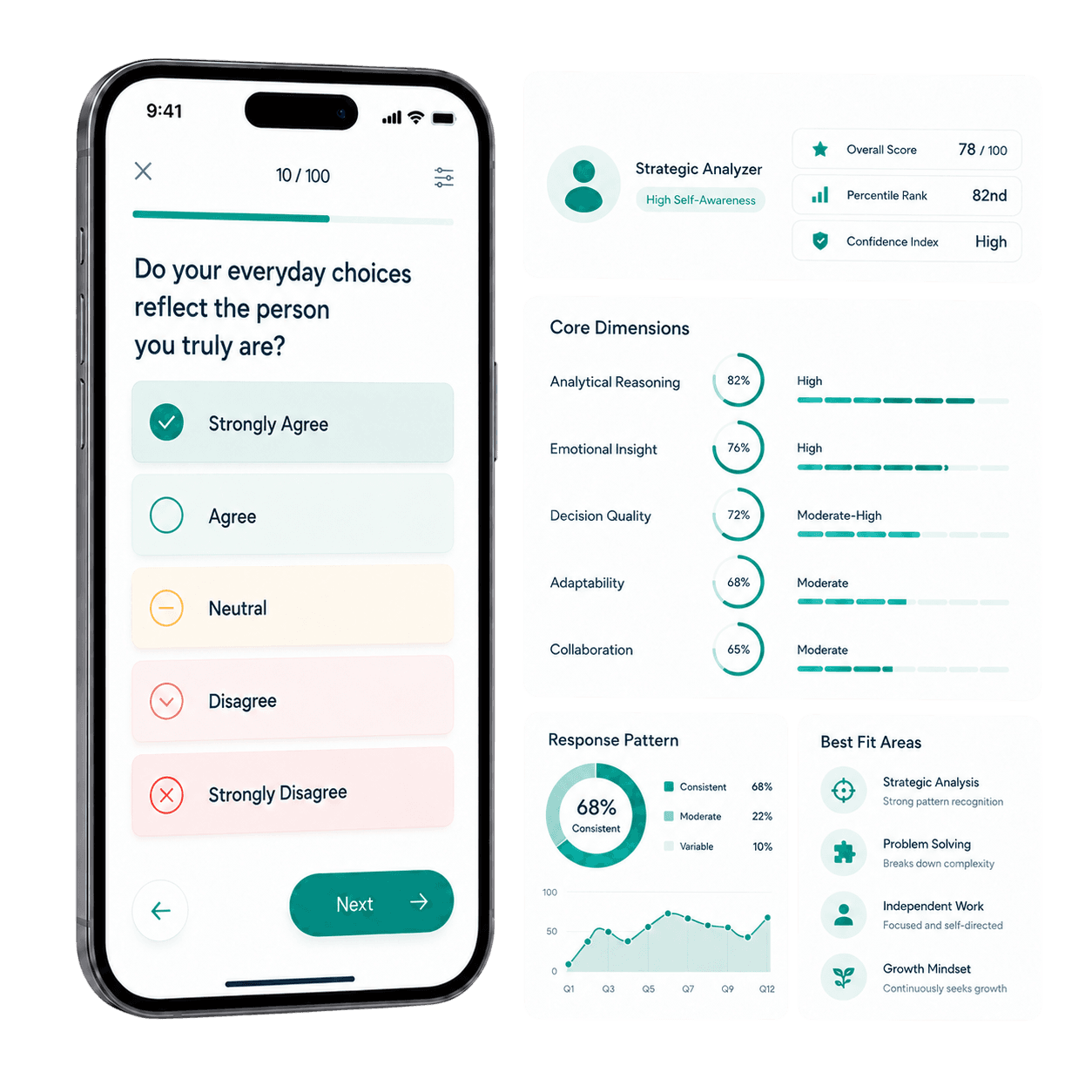
TestCore Career Strengths Test and personalised career-type report preview

Name the pattern before you try to sell the skill

Your result identifies one dominant career type and explains the strengths, work habits, environments, and trade-offs commonly associated with that pattern.

See what kind of value you create most naturally

Your strongest pattern may be practical execution, analytical problem-solving, communication, creativity, or leadership and direction.

  • The problems you notice quickly
  • The work others may rely on you for
  • The contribution that stays useful across roles

Understand where the strength becomes a blind spot

Every career type has trade-offs. A useful report shows where the same tendency that helps you can also become rigid, slow, scattered, overextended, or overly forceful when the context changes.

  • Strength without overuse
  • Context that changes performance
  • A development edge worth working on

Use the strength where it can compound

Look for projects, responsibilities, roles, and environments that use the pattern often enough for you to deepen it instead of treating it as an occasional bonus.

  • Projects that make the strength visible
  • Responsibilities worth growing into
  • Language for describing your value more precisely

How it works

1

Answer from situations where your contribution was obvious

Think about the work that felt natural to organize, solve, explain, create, or lead and the moments when other people began relying on you for it.

2

Identify the strongest of five career types

Your answers are compared across Builder, Analyst, Communicator, Creator, and Leader patterns to identify the dominant result.

3

Read the strengths and trade-offs behind the type

Use the report to understand where the pattern helps, where it can become limiting, and which work situations may let it become more valuable over time.

Frequently asked questions

Q

What strengths does this test measure?

The assessment compares broader work patterns associated with five career types: Builder, Analyst, Communicator, Creator, and Leader. It does not return a long list of independent skill scores.

Q

Does my result prove that I am highly skilled at that type of work?

No. The result reflects your self-reported tendencies and preferences. Skill level still depends on practice, experience, feedback, training, and the quality of your work.

Q

Can the same strength be useful in many industries?

Yes. Execution, analysis, communication, creativity, and leadership are useful across many fields. The industry changes the context; the contribution can remain recognizable.

Q

Will the report include weaknesses?

The report includes challenges and development themes associated with your dominant type as well as its strengths, so you can see where the same pattern may need balance.

Q

Can I use the result in interviews or career planning?

Use it as a prompt to find concrete examples from your own experience. The strongest interview language comes from evidence of what you did and the result you created, not from naming a test type by itself.

Q

How is this different from a skills test?

A skills test checks performance on a specific capability. This assessment identifies a broader career pattern from your self-reported preferences and working tendencies.

A strength becomes career leverage when it is specific enough to act on

“I am hardworking” is difficult to use. Knowing whether you are strongest at execution, analysis, communication, creation, or direction gives you a better place to look for evidence.

A dominant career type instead of a vague strengths list
The contribution behind the label
Blind spots that keep the strength honest
Work situations where the pattern can compound
Discover your career strengths
Takes around 10 minutesPrivate and secure