
Testcore

Find out which autism-related traits are occasional — and which ones keep returning.

Recognising a familiar description is easy. The more useful distinction is whether it repeats across time, survives different contexts and carries enough effort or impact to matter in everyday life.

Fast results
Secure
Private
Trusted by thousands of curious users
Rated 4.8/5by our users
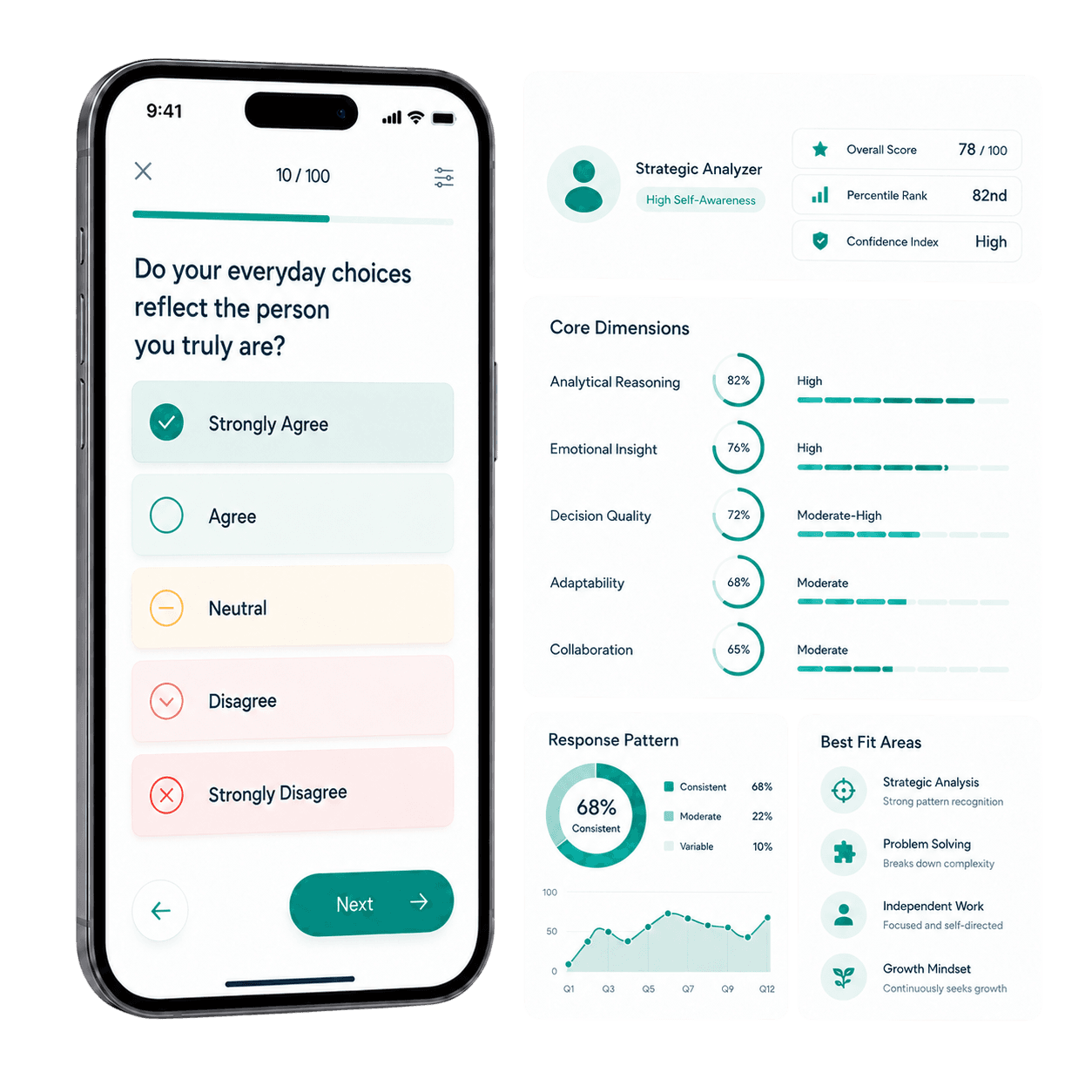
TestCore Autism Traits Test and personalised report preview

A trait matters differently when you add frequency, context and cost

This page is for people who already recognise some autism-related traits and want to judge them more carefully rather than collect a list of familiar descriptions.

Test whether the trait repeats

One difficult conversation, disrupted routine or overloaded afternoon is weak evidence. Compare whether the same experience returns across weeks, settings and ordinary demands.

  • What happens repeatedly
  • Where it appears
  • What has stayed consistent over time

Separate recognition from real-life impact

A description can sound familiar without changing much. The stronger question is whether it affects energy, comfort, communication, relationships, work, study or the support you need to get through a situation.

  • What simply sounds familiar
  • What creates friction or extra effort
  • What deserves closer attention

Keep the mixed evidence

A useful result does not require every trait to fit. Let the strong matches, weak matches and clear mismatches remain visible so the overall picture stays more credible.

  • Strong fits
  • Context-dependent traits
  • Descriptions that do not match

How it works

1

Answer from repeated examples

Use the pattern you see across ordinary life rather than the most memorable success or difficult moment.

2

Get one overall autism-traits level

Your answers are combined into a single result from Minimal Traits to Strong Traits. TestCore does not return a separate score for every trait or clinical domain.

3

Compare the result with context and impact

Use the report to see which traits remain consistent, which become stronger under load and which change when the environment is more supportive.

Frequently asked questions

Q

What are autism-related traits?

The phrase can include recurring differences in social communication, sensory processing, routine and predictability, focused interests, repetitive behaviours, flexibility and other ways of experiencing everyday situations.

Q

Does recognising many traits mean I am autistic?

No. Familiar traits can have different explanations. Autism diagnosis depends on a broader developmental and clinical assessment, not trait recognition alone.

Q

Will I get a separate score for each trait?

No. TestCore returns one overall autism-traits level and a detailed report. It does not provide independent numerical social, sensory, routine or communication subscores.

Q

Can traits look stronger under stress or sensory overload?

Yes. Stress, sleep, workload, environment, social demand and sensory load can change how strongly an experience appears. Answer from the broader pattern over time.

Q

Is this a validated autism screening tool?

No. TestCore uses its own self-report questionnaire. It should not be interpreted as an AQ, AQ-10, AQ-50, RAADS-R or other validated screening score.

Q

Can this test diagnose autism?

No. A professional assessment is needed to consider developmental history, patterns across settings, impact and alternative explanations in full context.

A trait becomes more useful when you know where it holds and where it changes

Context does not make a trait less real. It tells you more about the conditions that amplify it, reduce it or reveal the effort behind coping.

Compare frequency instead of relying on one memorable example
Keep easier settings in the picture as useful contrast
Separate familiarity from functional cost
Treat mixed evidence as information rather than a problem
See which traits keep returning
Takes around 10 minutesPrivate and secure