
Testcore

Give your own experience a fair hearing before you decide what label fits.

You may have spent years calling certain things quirks, overreactions or personal failures: needing more recovery, rehearsing conversations, protecting routines, avoiding overwhelming environments or working hard to look comfortable. Start by describing the pattern accurately.

Fast results
Secure
Private
Trusted by thousands of curious users
Rated 4.8/5by our users
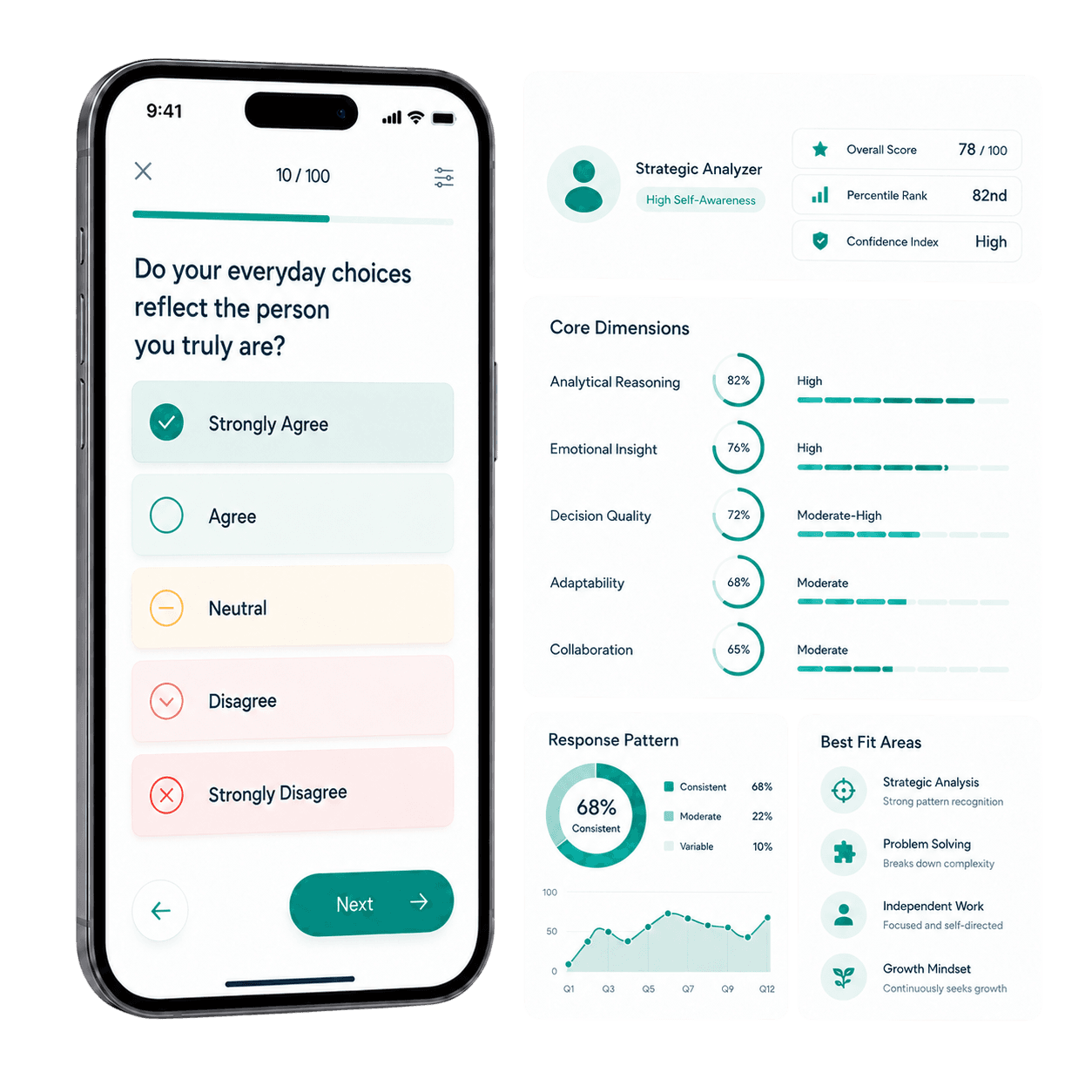
TestCore Autism Self-Reflection Test and personalised report preview

Self-reflection works better when you stop minimising the invisible parts

This route is less about proving autism and more about gathering the experiences you may have dismissed, compensated for or explained away.

Put the hidden effort back into the story

A successful outcome can hide rehearsal, scripts, rigid planning, sensory avoidance, conscious social monitoring or a long recovery period. Include that effort rather than reporting only whether you managed the situation.

  • Preparation before the situation
  • Effort while it is happening
  • Recovery after it ends

Separate what has always been there from what is recent

A longstanding pattern means something different from a change that appeared during burnout, anxiety, poor sleep, stress or another difficult period. Time course is useful information even when a self-report cannot explain the cause.

  • What feels longstanding
  • What changed recently
  • What depends heavily on context

Leave with observations that are easier to use

The result can help you move from vague self-judgement to specific examples about communication, sensory load, routine, focused attention and the conditions that make daily life easier or harder.

  • Clearer examples
  • More useful language
  • A better next conversation if you want one

How it works

1

Answer without needing a conclusion first

Use the questionnaire to gather what is already true in your daily life. You do not need to decide whether autism is the explanation before you begin.

2

Get one overall autism-traits level

TestCore combines the full self-report into one level from Minimal Traits to Strong Traits. It does not return a masking score or separate clinical profile.

3

Decide what deserves a next step

Use the report to sort what feels longstanding, what is context-dependent and what would be worth accommodating, discussing or bringing into a professional assessment.

Frequently asked questions

Q

Do I need to believe I am autistic before taking this test?

No. The page is designed for self-reflection. You can use it to organise recurring experiences without arriving with a conclusion in advance.

Q

What if I have learned to hide or compensate for some difficulties?

Include the effort behind coping. Some adults adapt or mask in ways that make their difficulties less visible to others. Preparation, conscious monitoring and recovery can still be relevant to your own reflection.

Q

Can this test tell whether a pattern comes from autism, ADHD, anxiety or stress?

No. Different conditions and life circumstances can overlap. The result can organise what you report, but it cannot establish the cause.

Q

Will I get a separate masking or sensory score?

No. TestCore returns one overall autism-traits level and a narrative report. It does not provide separate masking, sensory, social or routine subscores.

Q

Is this the AQ or RAADS-R?

No. TestCore uses its own educational self-report questionnaire and should not be interpreted as an AQ, RAADS-R or another validated clinical screener.

Q

When does professional assessment make sense?

Consider it if the pattern is longstanding, meaningfully affects daily life or support needs, or if you want a clinical answer rather than self-reflection. A qualified professional can add developmental history and differential assessment that an online test cannot provide.

You do not need a final label to stop dismissing the pattern

Self-reflection is useful when it replaces vague self-criticism with specific observations: what happens, where it happens, what helps and what it costs.

Count preparation and recovery as part of the experience
Separate longstanding patterns from recent changes
Keep alternative explanations open
Use clinical assessment when you need a diagnostic answer
Reflect on your autism traits pattern
Takes around 10 minutesPrivate and secure