
Testcore

See what happens when predictability breaks and a small change creates a much bigger cost.

A routine can be preference, support, or both. This page focuses on the moment a familiar sequence changes: how quickly stress rises, what becomes harder to process, and what helps you regain a sense of order.

Fast results
Secure
Private
Trusted by thousands of curious users
Rated 4.8/5by our users
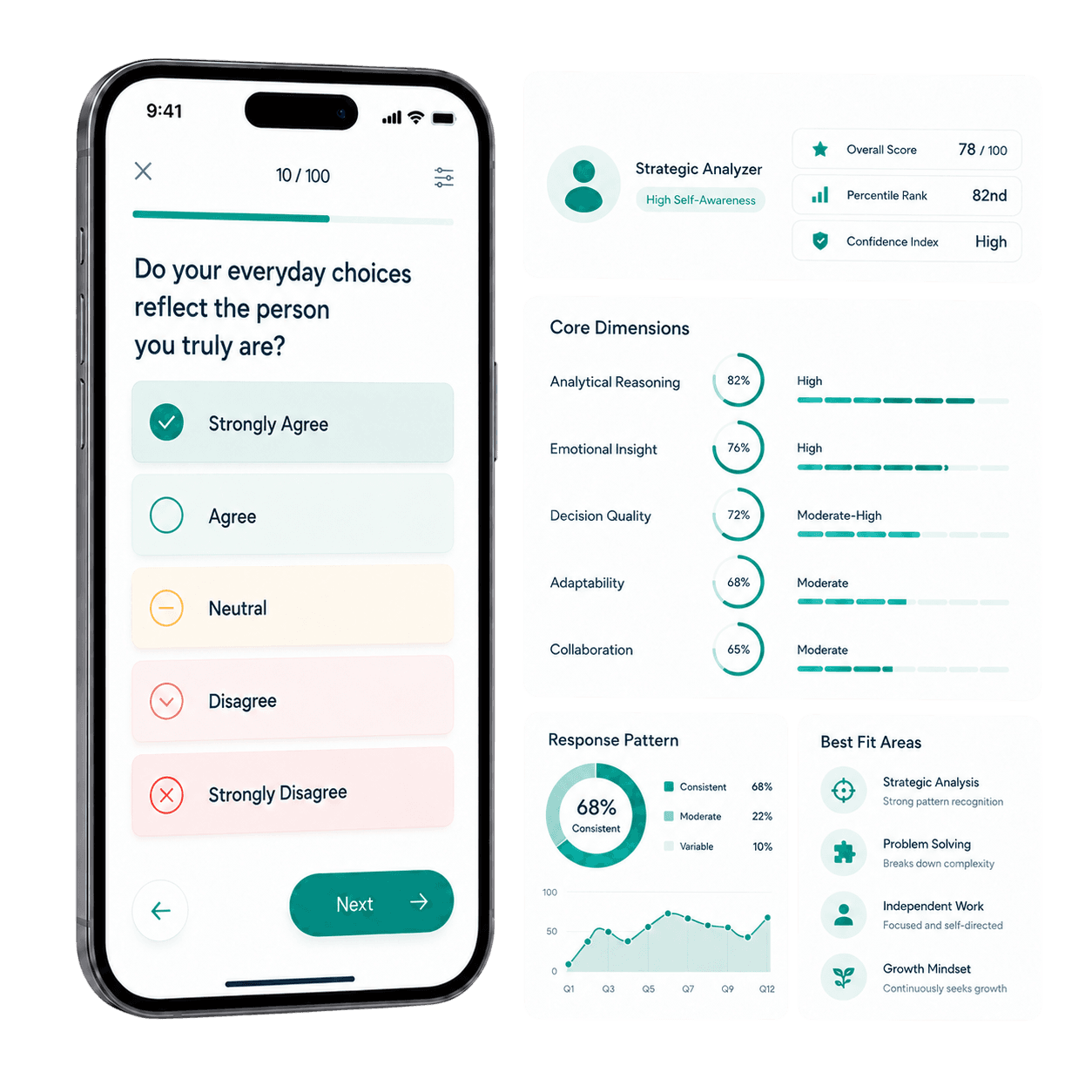
TestCore Autism and Routines Test and personalised report preview

The useful distinction is not routine versus spontaneity — it is what the structure does for you

The underlying assessment is broader than routines alone. This route uses the same autism-traits questionnaire to examine how predictability and change fit into your wider pattern.

Find the function of the routine

A routine may reduce uncertainty, protect energy, simplify decisions or make sensory and social demands easier to manage. Naming the function is more useful than deciding whether you are simply a routine-oriented person.

  • What the routine stabilises
  • What becomes harder without it
  • How much preparation it saves

Map the cost of an unexpected change

Look past the first reaction. A disrupted plan can affect concentration, emotional regulation, sensory tolerance or the ability to move smoothly into the next task.

  • The change itself
  • The immediate response
  • The knock-on effect afterwards

Use the result to protect the right kind of structure

The goal is not to eliminate routine. It is to understand which forms of predictability genuinely help, where flexibility is hardest and which transitions deserve more support or preparation.

  • Structure that helps
  • Transitions that cost most
  • Practical changes worth testing

How it works

1

Answer from ordinary disruptions

Think about delays, altered plans, interruptions, unfamiliar environments, changes in sequence and moments when you have to switch before you feel ready.

2

Get the broader autism-traits result

This route uses TestCore's full autism questionnaire. It does not return a separate routine, rigidity or intolerance-of-change score.

3

Read the routine pattern in wider context

Use the report to compare predictability with communication, sensory load, focused attention and the daily situations where change is easiest or hardest to absorb.

Frequently asked questions

Q

Does liking routines mean I am autistic?

No. Many people prefer routines. The more relevant questions are how strongly you depend on predictability, what happens when it changes and whether the pattern sits alongside other longstanding autism-related experiences.

Q

Will I get a separate routine score?

No. TestCore returns one overall autism-traits level. The questionnaire includes routine and flexibility among many other areas, but it does not provide an independent numerical routine score.

Q

Why can a small change feel disproportionately difficult?

A change can add uncertainty, task switching, sensory demand, new decisions and disrupted expectations at the same time. The practical cost may be larger than the visible change itself.

Q

Can routines be useful rather than a problem?

Yes. Predictable structure can reduce cognitive load, support planning and make demanding environments easier to navigate. The useful question is whether the routine supports your life or whether disruption creates a level of distress or limitation you want to understand better.

Q

Is this a clinical autism screening tool?

No. TestCore uses its own self-report questionnaire and does not provide an AQ, RAADS-R or other validated screening score.

Q

Can this test diagnose autism?

No. A diagnosis requires a broader professional assessment that considers developmental history, persistent patterns across settings, daily impact and other possible explanations.

A routine can be a support system hiding in plain sight

The key question is what predictability makes possible. When a routine breaks, the resulting cost can reveal how much structure was carrying in the first place.

Look for the function of the routine, not only the habit itself
Track what changes after an unexpected transition
Protect useful structure without treating flexibility as a moral test
Use professional assessment for diagnosis or clinical guidance
See how change affects your pattern
Takes around 10 minutesPrivate and secure