Testcore

Take an attention and focus test for real-life concentration, not click speed.

This is a self-report questionnaire, not a reaction-time or target-detection task. It asks how attention behaves across ordinary responsibilities: whether it drifts, whether you can return after an interruption, and whether some tasks hold you while others repeatedly fall apart.

Fast results
Secure
Private
Trusted by thousands of curious users
Rated 4.8/5by our users
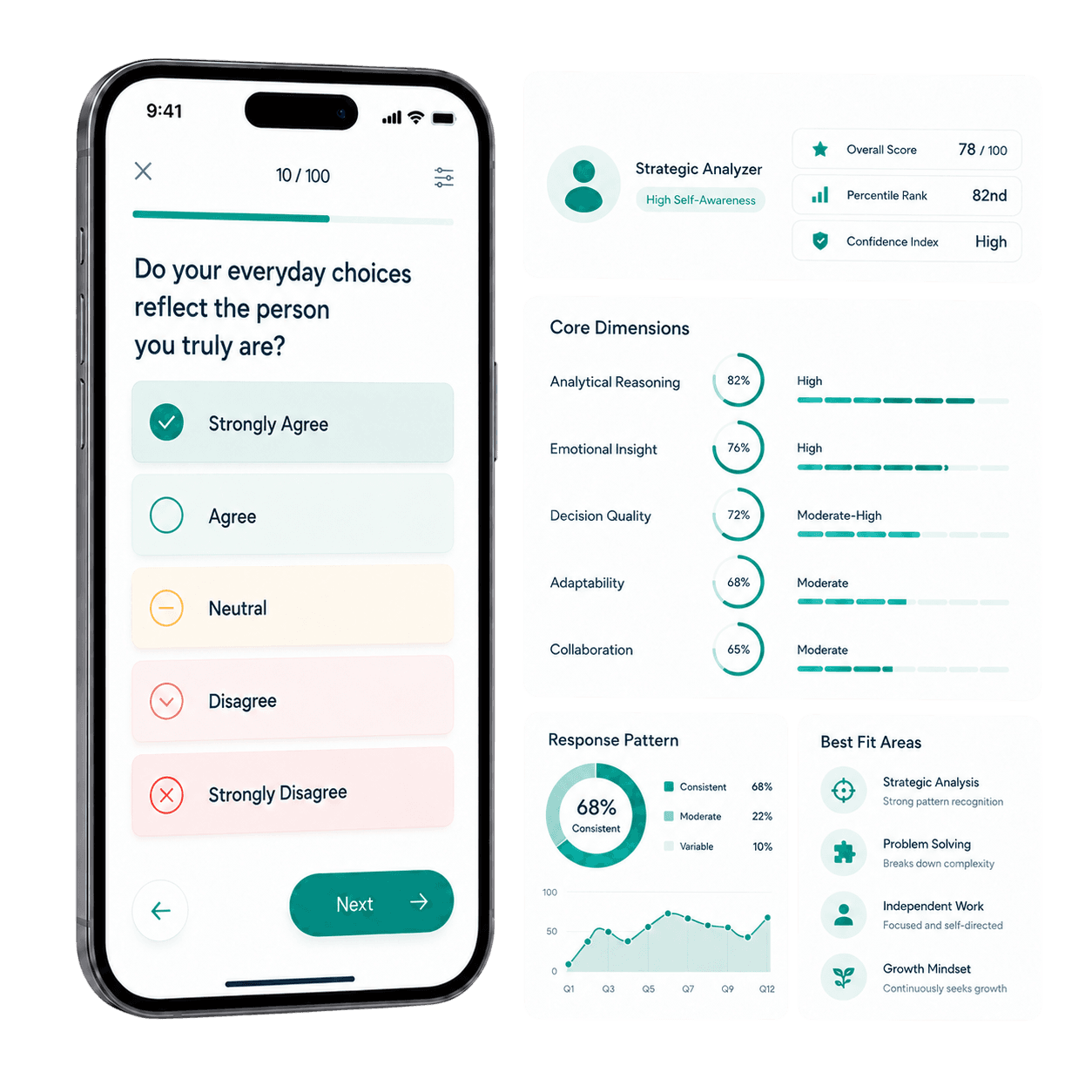
TestCore Attention and Focus Test and personalised report preview

Measure the experience you actually want explained

Some online focus tests measure milliseconds and missed targets. TestCore looks at your reported pattern across days and responsibilities. If your question is about everyday attention rather than browser performance, this is the relevant version.

See when focus holds — and when it does not

Concentration can be strong when a task is interesting or urgent and unreliable when it is repetitive, lengthy, interrupted, or competing with several open demands. That contrast is more informative than calling yourself simply focused or unfocused.

  • Interesting versus routine tasks
  • Quiet versus interrupted settings
  • Urgent versus open-ended work

Count the cost of getting back on task

The problem is not always the first distraction. Sometimes the real cost is how long it takes to return, rebuild the train of thought, or remember what you were about to do next.

  • How easily you resume
  • What gets lost after interruption
  • How often momentum has to be rebuilt

Use the result to test a practical change

A useful result gives you a question you can act on: whether fewer interruptions, clearer structure, shorter work blocks, external reminders, or professional assessment would be worth trying next.

  • Change one condition at a time
  • Watch whether the pattern shifts
  • Escalate to professional assessment when needed

How it works

1

Answer from real settings

Think about reading, meetings, conversations, admin, household tasks and work that has to be resumed after interruptions.

2

Get the broader ADHD-traits result

This route uses TestCore's ADHD self-report questionnaire. It does not produce a separate reaction-time score or isolated clinical focus subscore.

3

Read the report against your hardest focus conditions

Use the result to compare where attention becomes costly and which change would be most useful to test in daily life.

Frequently asked questions

Q

Is this a reaction-time or cognitive attention test?

No. TestCore does not measure how quickly you click, how many targets you detect, or your processing speed. This is a self-report questionnaire about attention and related patterns in everyday life.

Q

Why does the Attention and Focus Test use the ADHD questionnaire?

Attention rarely exists in isolation from organisation, time, follow-through, restlessness or impulsive responses. The underlying questionnaire is broader so the result can place focus difficulties in that wider context.

Q

Will I get a separate focus score?

No. Your responses produce one overall ADHD-traits level and a narrative report. TestCore does not return an isolated attention or concentration subscore.

Q

Why can I focus well on some tasks but not others?

Attention can vary with interest, urgency, stimulation, interruptions and task demands. Strong focus in one situation does not automatically explain what happens in another.

Q

Can this Attention and Focus Test diagnose ADHD?

No. ADHD diagnosis requires a broader assessment that considers persistence, impairment across settings, developmental history and other possible causes of attention problems.

Q

What happens after I finish?

Your answers produce one overall ADHD-traits level. TestCore then presents the report offer where you can unlock the detailed interpretation.

Good performance can hide how expensive focus feels

Finishing the work does not tell you how many restarts, reminders, deadline surges or quiet-room workarounds it took to get there. A self-report test is useful when the effort behind the outcome is the part you are trying to understand.

Judge the effort behind the result, not only whether the task got done
Compare focus under different levels of structure and interruption
Use practical changes as experiments, not proof of a diagnosis
Seek professional assessment when the pattern is persistent and disruptive
See your focus pattern
Takes around 10 minutesPrivate and secure