Testcore

Find out which anxiety-related traits keep returning across different situations.

A stressful week can make anyone feel on edge. Traits are more interesting when the same tendencies repeat: replaying, preparing for every possibility, struggling with uncertainty, or avoiding situations until they feel safer.

Fast results
Secure
Private
Trusted by thousands of curious users
Rated 4.8/5by our users
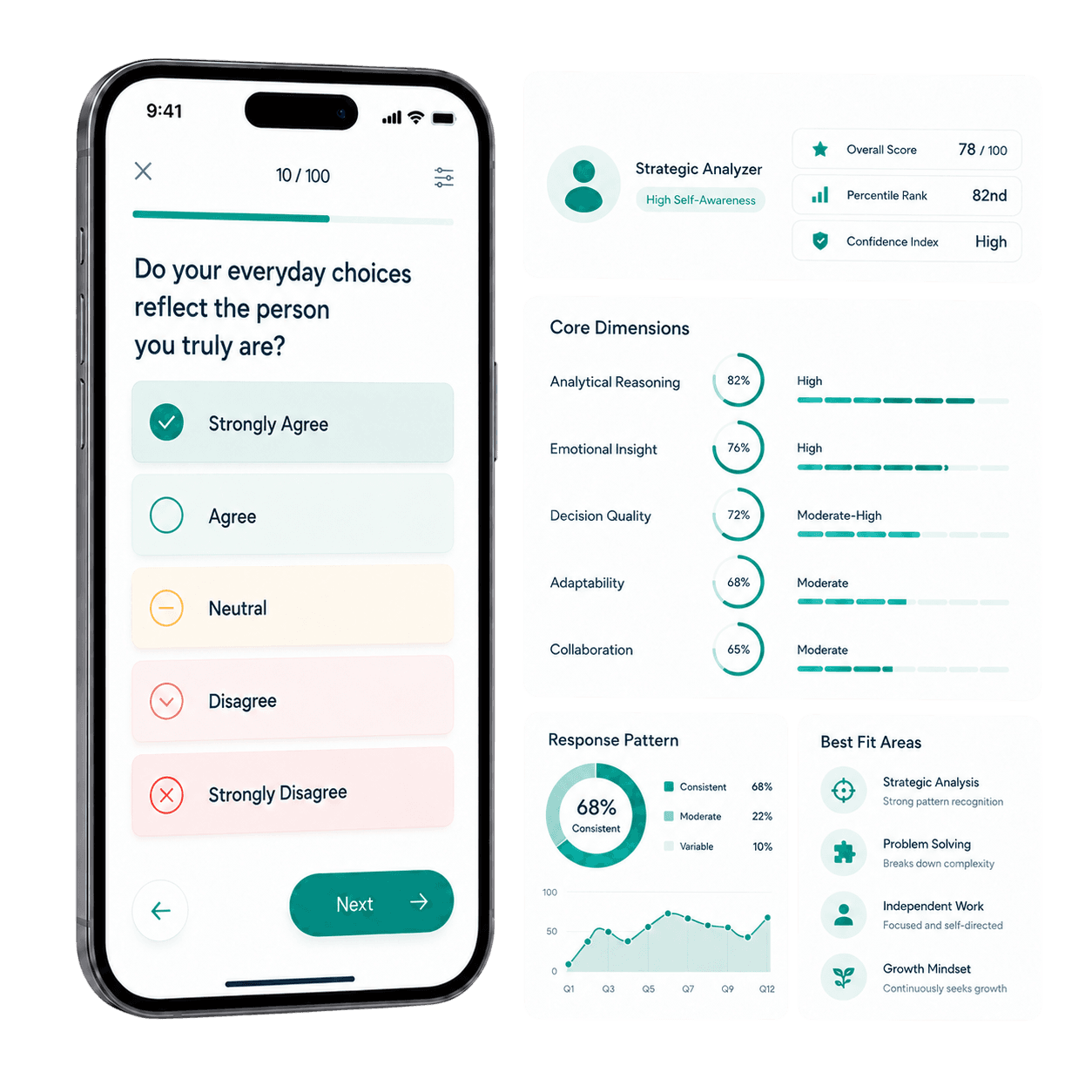
TestCore Anxiety Traits Test and personalised report preview

Separate a passing reaction from a pattern that keeps returning

This page is about recurring tendencies, not one bad day. The assessment helps you look for what stays recognisable across changes in workload, relationships, decisions, and uncertainty.

Notice what repeats across contexts

Look for tendencies that show up in more than one setting, such as anticipating problems, replaying interactions, feeling unable to switch off, or needing more certainty before acting.

  • What appears in several parts of life
  • What fades when the situation changes
  • What has become easy to dismiss as 'just how I am'

Compare recognition with impact

A trait can feel familiar without being equally costly everywhere. See where anxiety-related tendencies mainly stay in the background and where they begin affecting time, energy, confidence, or choices.

  • How strongly the tendency affects daily life
  • Where extra effort is required
  • Which situations make the pattern more visible

Keep the useful detail, not the label

Your report gives the overall result context across stress, relationships, communication, work, and decision-making so you can use what fits without turning a traits result into a fixed identity.

  • One overall anxiety-traits level
  • Context around recurring tendencies
  • A more precise description of what you notice

How it works

1

Answer for what is typical

Choose the response that best matches your usual experience across time, not the version of yourself from your best day or your most stressful one.

2

See the recurring pattern as a whole

The questionnaire combines anxiety-related experiences across thinking, tension, social situations, uncertainty, and avoidance into one overall traits result.

3

Decide what deserves attention

Use the report to distinguish tendencies that are simply familiar from those that repeatedly cost you sleep, focus, confidence, time, or freedom to act.

Frequently asked questions

Q

What are anxiety-related traits?

In this assessment, the phrase refers to recurring self-reported tendencies associated with anxious thinking, tension, social unease, reactions to uncertainty, and avoidance. It is descriptive language, not a clinical diagnosis or personality classification.

Q

How is an anxiety traits test different from asking how anxious I feel today?

A current-state question is about a recent moment. This assessment asks you to answer from what is usually true, which makes recurring patterns more relevant than a single unusually calm or difficult day.

Q

Will I get a separate score for each trait?

No. The answers contribute to one overall anxiety-traits level. The report provides broader context, but TestCore does not present separate clinical subscale scores for each area.

Q

Is the Anxiety Traits Test a diagnosis?

No. A self-report result cannot confirm or rule out an anxiety disorder. Diagnosis requires professional assessment in the context of symptoms, history, duration, and impact.

Q

Can anxiety-related traits change?

Yes. How strongly a tendency appears can shift with stress, environment, support, habits, and experience. A traits result describes your answers now; it does not define a permanent identity.

Q

When should I consider additional support?

Consider qualified support if anxiety-related experiences are persistent, distressing, worsening, or interfering with everyday functioning or safety.

A recurring trait is useful to notice only when you understand its context

Being cautious, thoughtful, prepared, or sensitive to risk is not automatically a problem. The more useful distinction is what the tendency does to your life when pressure or uncertainty rises.

Compare the same tendency across work, relationships, decisions, and quiet time
Notice when preparation becomes repeated checking or when caution becomes delay
Separate a familiar personal style from patterns that repeatedly create distress or extra effort
Use the result as context for a next step rather than as a permanent label
Explore your anxiety traits
Takes around 10 minutesPrivate and secure