Rules, honesty, and responsibility
Notice repeated disregard for rules, deception for personal gain, broken obligations, or rationalizing behavior after someone else bears the cost.
- Rules and norms
- Honesty and exploitation
- Responsibility

Clinical descriptions of antisocial personality disorder include persistent disregard for others' rights, deceitfulness, impulsivity, aggression, recklessness, irresponsibility, and lack of remorse. This broader self-reflection test touches several related themes, but it cannot assess every diagnostic criterion or required history.
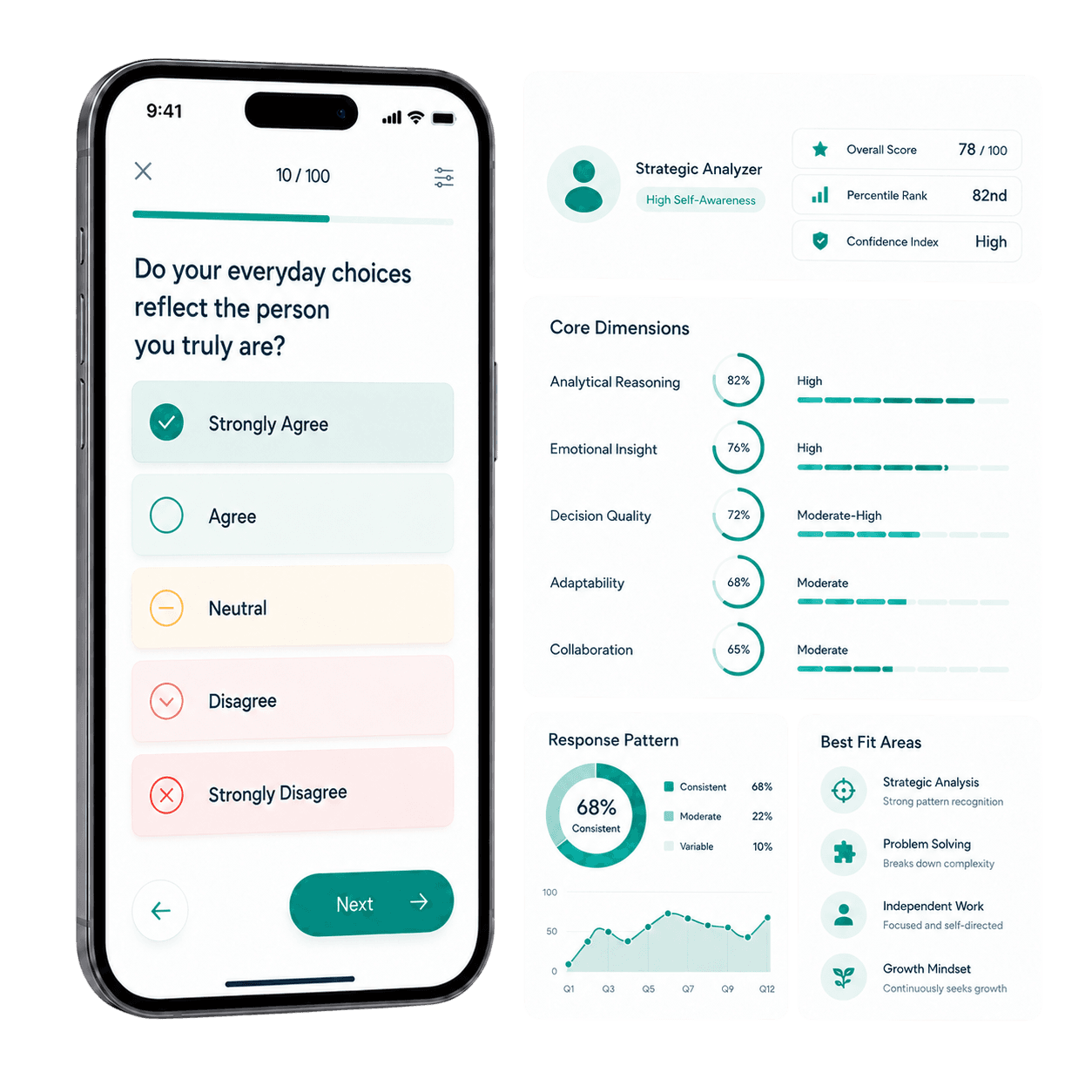
The product returns one overall sociopathic-traits level. This page uses an antisocial-traits lens without pretending the output is a clinical ASPD screen.
Notice repeated disregard for rules, deception for personal gain, broken obligations, or rationalizing behavior after someone else bears the cost.
Look at fast decisions, conflict escalation, reckless choices, and whether foreseeable consequences for yourself or others meaningfully slow you down.
The practical question is not only whether regret appears, but whether accountability and consequences alter what happens the next time a similar situation occurs.
Use repeated patterns rather than one event. Clinical antisocial patterns are defined by persistence, and this self-report is most useful when you answer the same way.
You receive one overall sociopathic-traits level, not an ASPD diagnosis and not a count of DSM criteria.
If the pattern is causing repeated harm, aggression, exploitation, legal problems, or loss of control, professional support is more useful than repeated online testing.
No. It is a broader educational self-report that overlaps with some antisocial trait themes but cannot establish the full criteria or developmental history required for antisocial personality disorder.
One overall Level 1–5 sociopathic-traits result with explanatory report content.
No. It is not a DSM checklist and does not count diagnostic criteria.
No. A high self-report score does not establish ASPD.
No. It does not predict crime, violence, or dangerousness.
Formal ASPD diagnosis includes developmental requirements that cannot be inferred from this current self-report. That is one reason an online traits test cannot replace professional assessment.
Use this route to understand the behavior themes behind the query while keeping a firm boundary around what the actual product can establish.